
We all use ChatGPT to write an email in seconds.
You ask ChatGPT to write an email for your next promotion.
The first version sounds like a corporate announcement. Not really what you wanted.
So you ask it to make the email more friendly.
Much better. Except it has now removed an important detail about your offer.
You tell it to put the detail back.
Done. But this time, ChatGPT has decided your product includes a bonus you never mentioned.
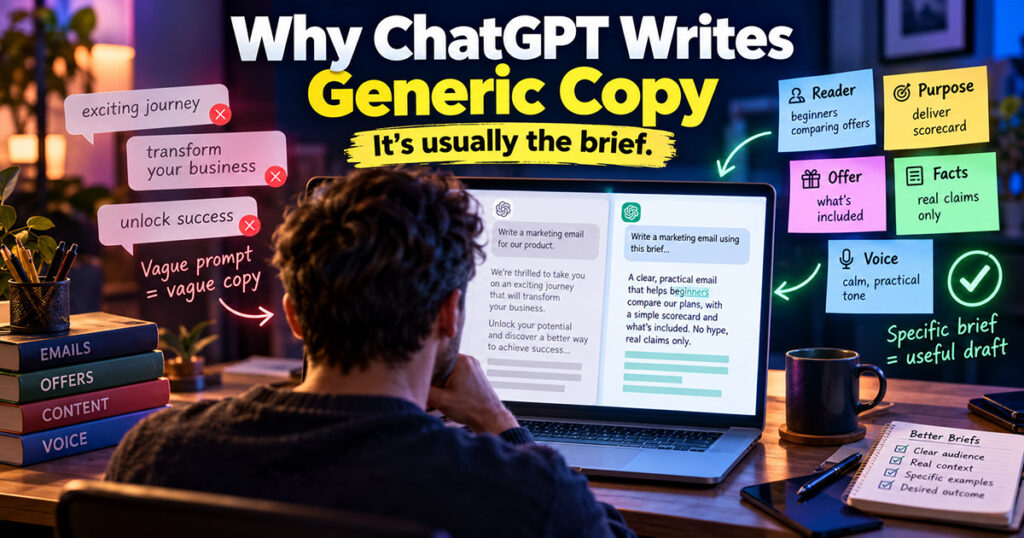
And here we go again...
Five prompts later, you're still working on the same email. And you start wondering whether writing it yourself would have been faster.
Sounds familiar?
This is one of those problems with AI content creation that doesn't get enough attention.
Generating content is fast. Getting content ready to publish can be a completely different story.
And if we're spending more time correcting AI than we would spend doing the work ourselves, what's the point?
Let's see what we can do about it.
Why ChatGPT keeps getting it wrong
The first thing you need to understand is that not every bad draft has the same problem.
Sometimes ChatGPT doesn't have enough information.
Sometimes it misunderstands who you're writing for.
And sometimes your instructions are simply too broad, leaving the AI to decide things you should have decided yourself.
There's also the possibility that you're asking it to do too much at once.
The important thing is to identify which problem you're dealing with before you start another round of rewriting.
Because a different problem needs a different solution.
And no, switching to a more advanced model isn't necessarily the answer.
At least not yet.
Stop telling ChatGPT to "make it better"
Think about it.
What does "make it better" actually mean?
Better for whom? In what way?
Should ChatGPT make your email shorter? More persuasive? More friendly? Should it change the opening, rewrite the offer, or add a stronger call to action?
You probably know exactly what's wrong with your draft.
But ChatGPT doesn't.
So when you give it a general instruction, you're allowing it to change things that were already perfectly fine.
And that's where many of those endless corrections begin.
Here's a much better approach.
Instead of saying:
"Make this email more persuasive."
Try something like:
"The opening is too formal. My readers already downloaded the free checklist, so don't introduce it again. Keep the rest of the email and rewrite only the first two paragraphs."
See the difference?
You're telling ChatGPT exactly what needs to change AND what needs to stay.
Here's another example:
"Keep the price at $37 and the deadline at Friday midnight. Remove the guaranteed-results claim because we don't offer that. Don't change anything else."
Simple. Specific. Much easier to control.
The trick is to correct the problem, not regenerate the whole thing.
And if your draft has several problems, there's something else you can do before asking for another version.
Ask ChatGPT to explain the assignment back to you.
Who are we writing for? What's the offer? What do we want the reader to do? Which details must remain unchanged?
If it gets these things wrong, why would you expect the next draft to be right?
Fix the understanding first.
Then fix the writing.
Make your decisions BEFORE generating the content
Here's another mistake that's surprisingly easy to make.
Imagine you're preparing a five-email promotional sequence for a new guide.
You open ChatGPT and ask it to write all five emails.
A few seconds later, you have your sequence.
Wonderful, right?
Well... Not necessarily.
You read through the emails and notice they're all saying more or less the same thing.
So you ask for more variety.
Now ChatGPT adds a discount that doesn't exist.
You correct that, and the next version suddenly mentions an extra bonus that isn't included.
Back to rewriting.
But the real problem isn't necessarily the model.
You skipped the planning part.
Before writing five emails, you should decide what each email is supposed to accomplish.
For example:
- Email 1: Deliver the free guide and explain how to get started.
- Email 2: Show one practical way to use the information.
- Email 3: Answer a common question or objection.
- Email 4: Help the reader understand what to look for before making a decision.
- Email 5: Introduce the complete resource and invite the reader to take the next step.
Now each email has its own purpose.
ChatGPT doesn't have to invent the strategy while writing the content.
And you're much less likely to get five variations of the same promotional message.
The same goes for longer blog posts.
If you want a 1,500-word article, don't start by asking for 1,500 words.
Ask for the main angle and outline first.
Review those. Make sure they're correct.
Only then ask ChatGPT to write the article.
It's much easier to fix six lines of an outline than to rewrite an entire article because it went in the wrong direction.
Makes sense, doesn't it?
Give ChatGPT the right facts. In ONE place.
Here's something I see as especially important when working on marketing content.
Your offer has certain facts that simply cannot change.
Product name. Price. What's included. What's NOT included. Deadline. Bonuses. Target audience.
These are not creative suggestions.
They're facts.
But if you mention the price in one prompt, describe the bonus three messages later, and correct the deadline after another five messages, things can get messy.
Especially when you're working on a longer campaign.
A simple solution is to create what I call an Offer Sheet.
Nothing complicated.
Just a short document containing:
- Product name and description
- Target audience
- Main benefits and deliverables
- Current price, if public
- Real deadline, if there is one
- Approved bonuses
- Restrictions and things NOT to promise
- The action you want readers to take
That's it.
Then tell ChatGPT to use this document as the source of factual information.
If something isn't included in the sheet, ChatGPT shouldn't invent it.
And if you change the price or deadline, update the document.
Don't expect the model to magically know which information is the latest when you've given it conflicting details.
One more thing.
ChatGPT correcting a draft doesn't mean your published content has been corrected, too.
If you've already scheduled emails, published a landing page, or prepared social posts, you still need to check those separately.
AI doesn't automatically fix everything you've already published.
Start tracking what you keep correcting
This might sound like additional work, but hear me out.
For the next week, pay attention to the corrections you're making to your ChatGPT drafts.
You don't need a complicated spreadsheet.
Just write down the main problem.
Something like:
- Wrong audience
- Invented bonus
- Missing price
- Repeated opening
- Too formal
- Changed the deadline
That's enough.
After several days, look at your list.
Do you notice the same problem appearing again and again?
If so, you may have found something you can fix permanently.
For example, if ChatGPT repeatedly writes for beginners when your audience is experienced marketers, your audience description probably needs some work.
If it keeps inventing bonuses, make your offer sheet more restrictive.
If every email starts with a long, boring introduction, give it a saved instruction to start with the useful information instead.
Fix the recurring problem once instead of correcting it in every single draft.
This is where saved instructions and good writing samples can make a real difference.
And if you're working on a longer project, keep a short voice description or an example of your own writing nearby.
You shouldn't have to explain your preferred tone every time you start a new task.
Not if you can give ChatGPT a good example to follow.
What if the model itself is the problem?
Of course, not every problem can be solved by writing better instructions.
Sometimes the task is simply more complicated.
Let's say you're working on a campaign with several products, different customer groups, multiple emails, landing pages, and social posts.
Everything needs to match.
The right offer must go to the right audience. Prices and deadlines must be consistent. Messages shouldn't contradict one another.
That's a different job from writing a simple promotional email.
And it's a reasonable situation to test whether a different model handles the work better.
For example, you could compare GPT-6 and GPT-5.6.
But here's what I wouldn't do.
I wouldn't ask both models to write something and then choose the version that sounds nicer.
Why?
Because a beautiful email that contains the wrong price or promises a bonus that doesn't exist isn't a good email.
It's a problem waiting to happen.
Instead, give both models the SAME information and the SAME assignment.
Then compare what happens.
Which one follows your instructions more closely?
Which one keeps the facts correct?
Which one needs fewer substantial corrections?
And most importantly...
How long does it take to get from the first prompt to an approved, ready-to-use result?
That's the number that matters.
Not the time it takes the model to generate a draft.
If GPT-6 produces something in seconds but needs 30 minutes of corrections, while GPT-5.6 gives you a usable result with just a couple of changes, which one actually saved you time?
Exactly.
And the opposite can be true on another task.
That's why I recommend testing models on your actual marketing work instead of relying on general claims about which model is better.
One test doesn't prove everything.
But several similar tasks can tell you quite a lot.
Oh, and if BOTH models keep making the same mistake, check your instructions before blaming either one.
You may have an unclear requirement somewhere in your original information.
Know when to STOP rewriting
This one is important.
You can keep improving almost any piece of content forever.
Change the headline. Rewrite the introduction. Make a paragraph shorter. Replace one word. Try another closing.
There's always something you can tweak.
But does every little change really make the content better?
Not necessarily.
Before you start, decide what a successful result looks like.
For most marketing content, I'd use four simple checks:
- Facts are correct. No invented promises, bonuses, prices, or deadlines.
- The reader understands the offer. What it is, who it's for, and why it might be useful.
- The tone fits. It sounds like something you'd actually write or say.
- The next step is clear. Your reader knows what to do if interested.
If all four are covered, your content may already be good enough to publish.
Don't spend another hour changing words that make no practical difference.
And here's a simple rule I'd suggest trying.
If two focused corrections don't solve the problem, stop requesting complete rewrites.
Go back to the assignment.
Maybe your instructions aren't specific enough.
Maybe you're asking ChatGPT to handle too many things in one step.
Or maybe it's time to test a different model.
You can always adjust the rule to fit the kind of work you're doing.
The point is to avoid getting stuck in a cycle where every new draft fixes one thing and breaks another.
So, is ChatGPT really saving you time?
It certainly can.
But generating text quickly and finishing your marketing work quickly are two different things.
And that's something worth remembering.
A five-second draft that needs 40 minutes of corrections isn't necessarily better than a draft that takes a little longer but gets the job done with minimal editing.
What really matters is how much work you have to do before the content is ready to use.
Sometimes a better prompt is all you need.
Sometimes you need to approve the outline before writing the article.
Sometimes an Offer Sheet will prevent half of your usual corrections.
And sometimes, yes, a different model will do a better job.
The goal isn't to generate more drafts. It's to finish more work in less time.
Which brings me to something you might find useful.
I've put together an ebook called Choosing GPT-6 or GPT-5.6 for Everyday Marketing.
It explains how to compare these models using your own marketing tasks, what to look for in their output, and how to measure the corrections that actually cost you time.
So instead of guessing which model to use, you can make a much more informed decision.
And next time ChatGPT gives you something that needs another rewrite, remember...
Maybe you don't need another draft.
Maybe you just need to fix the way you're asking for it.