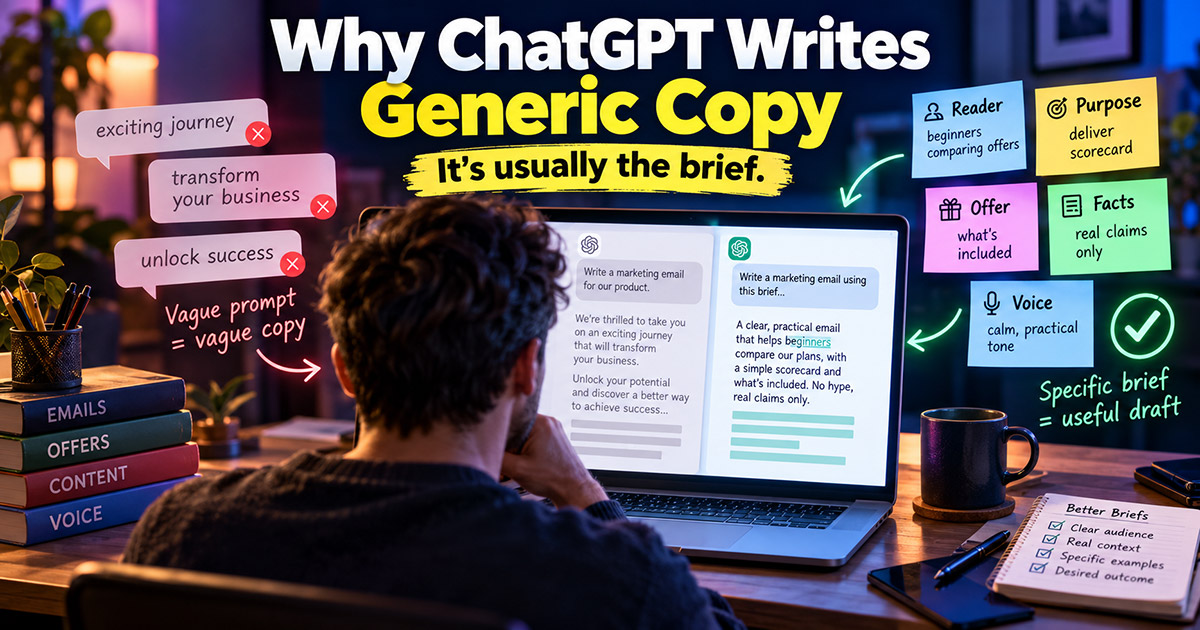
How is ChatGPT choosing the audience?
You tell ChatGPT to write an email promoting your beginner-friendly offer.
The result looks good. Professional, persuasive, and nicely structured. There's just one problem.
Your readers won't understand half of it.
The email talks about conversion funnels, advanced segmentation, and campaign optimization. All perfectly valid marketing terms, of course. But your subscribers are still trying to figure out which affiliate product to promote.
So you explain the problem and ask ChatGPT to simplify the message.
And now it goes too far in the other direction. It starts explaining what an email list is and why people subscribe to one.
Seriously?
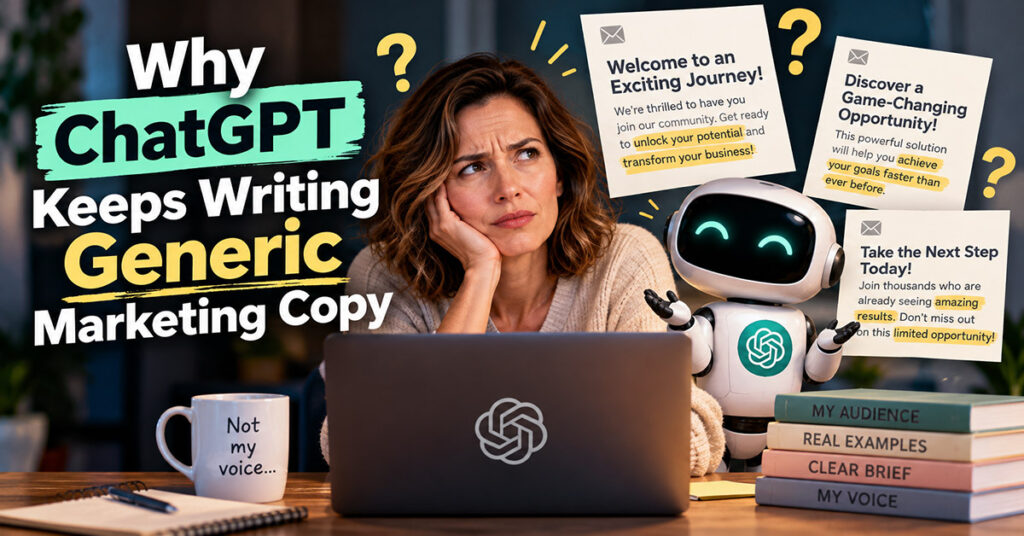
Your readers aren't complete newcomers to the internet. They know what email marketing is. They simply haven't built a successful campaign yet.
This is what happens when ChatGPT doesn't know who you're actually writing for.
And the problem isn't necessarily obvious. The copy can be grammatically perfect, sound convincing, and still miss the people you're trying to reach.
The reader either feels lost because you're talking above their level, or gets bored because you're explaining things they already know.
Neither situation is good for your marketing.
Your audience isn't just a label
Let's say you're promoting an affiliate marketing course.
You tell ChatGPT your target audience is beginners.
Fair enough. But what does beginner actually mean?
Someone who has never heard of affiliate marketing? Someone who understands the concept but hasn't chosen a niche? Or someone who already has a website, an email list, and a few campaigns that haven't produced results?
These are three very different people.
Yet ChatGPT may treat them as one group because that's all you've told it.
And then we wonder why the copy doesn't connect.
The solution is to describe what your readers know, what they've already done, and what they're trying to accomplish next.
For example:
"These are new subscribers who have already chosen their affiliate niche but haven't selected a product to promote. They understand the basics of affiliate marketing, but they don't know how to compare offers."
See the difference?
Now ChatGPT has something useful to work with. It knows where your readers are in the process and which problem your message should address.
You don't need to invent an entire customer biography. Their age, hometown, favorite coffee, and imaginary personality aren't going to help much here.
You need information that affects the message you're writing.
What does your reader already know?
Before creating your next email or blog post, think about the person who will read it.
How did they arrive here? What have they already received from you? Which problem are they trying to solve? What would make sense as their next step?
Let's take a simple example.
You have a free offer scorecard that helps affiliate marketers compare products before promoting them.
Two people might come across your next piece of content.
The first downloaded your scorecard yesterday. They know what it is, but they haven't used it yet.
The second sees your social media post for the first time. They've never heard about your scorecard.
Would you explain the same things to both?
Probably not.
The first person needs help using what they already have. The second needs to understand why comparing offers is important in the first place.
If you write one message without considering this difference, you'll likely explain too much to one group and too little to the other.
And that's completely unnecessary.
A simple addition to your ChatGPT instructions can prevent it.
What they know: "These readers understand basic affiliate marketing and have already downloaded my offer scorecard."
What they don't know: "They haven't seen my paid guide or its contents, and they haven't compared products using a consistent process."
Two sentences. That's all.
Of course, the information must be accurate. Don't tell ChatGPT something about your readers just because it sounds reasonable.
Use what you actually know from their subscriptions, purchases, questions, and previous interactions.
Check the first paragraphs before anything else
Here's a simple test I recommend.
Take the first two paragraphs of your ChatGPT draft and imagine one real person from your audience reading them.
Maybe someone who downloaded your checklist yesterday. Or a customer who bought your beginner course last month.
Would they immediately understand why you're talking to them?
Would they recognize their situation?
And would they understand the language you're using?
If the answer is no, you've probably found an audience mismatch.
You don't necessarily need to rewrite the entire email.
Tell ChatGPT exactly what needs changing.
For example:
"Rewrite the first two paragraphs for subscribers who downloaded my free worksheet but haven't purchased the paid guide. They already know the basics of affiliate marketing. Keep the offer details unchanged."
That's much more useful than asking it to make the email more engaging.
You're correcting a specific problem instead of inviting ChatGPT to change everything.
And once you have a version that works, save it.
You can use it as a reference next time you're writing to the same group. No need to explain your audience from scratch every single time.
Different customers may need different offers
Now, this becomes even more important when you're selling several products or different versions of the same product.
Imagine you're promoting a training package.
New customers can purchase the standard version. Existing customers qualify for an upgrade.
Simple enough, right?
But if you ask ChatGPT to create a promotional email sequence without explaining who qualifies for what, you might end up with an unpleasant surprise.
The upgrade gets promoted to everyone.
Or the new-customer email mentions a feature that's available only in the upgrade package.
The writing may still sound excellent.
Unfortunately, excellent writing doesn't help when you're offering the wrong product to the wrong people.
And now you have confused customers, support questions, and possibly refund requests to deal with.
The solution?
Create a simple audience-to-offer map before asking ChatGPT to write anything.
For each group, specify:
- Who belongs to the group.
- What they've already purchased or received.
- Which product or upgrade they're eligible for.
- What the offer includes.
- Which purchase link they should receive.
If you don't know whether a group qualifies for a particular offer, verify that information first. Don't let ChatGPT guess.
I would also ask it to summarize this map before generating the emails.
Why?
Because it's much easier to spot a misunderstanding in a short summary than in five completed sales emails.
Approve the audience and offer details first. Then let ChatGPT write the messages.
If you're serving several groups, request separate versions and review them side by side.
The explanations can be different. The sales angles can be different. Even the calls to action can be different.
But the facts about your products must remain consistent.
If your package includes three worksheets, it includes three worksheets regardless of which customer group you're writing to.
Watch out for assumptions disguised as good copy
Some phrases look perfectly natural in a marketing email.
Until you think about what they actually imply.
Take this one:
"As you already know..."
Do they?
Or are you assuming every subscriber has read your previous emails?
How about:
"Even if you're starting from zero..."
That might work for complete beginners. But what about readers who've already spent months building their first campaign?
You're effectively telling them their previous work doesn't count.
And then there's:
"Finally, the solution you've been looking for."
Maybe. But how do you know they've been looking for it?
Good copy doesn't need to pretend it knows things about the reader that you can't possibly know.
A better approach is to describe a recognizable situation.
For example:
"If you've already shortlisted a few affiliate offers but can't decide which one to test first, these questions can help you narrow your choices."
Much better.
It speaks directly to people facing that problem without suggesting everyone has the same experience.
When reviewing your draft, ask yourself one question:
What would have to be true about my reader for this sentence to make sense?
If you can't answer that using real information about your audience, consider changing the sentence.
And don't forget about customer questions.
If several people ask whether your software works without a website, that tells you something useful.
If customers keep asking how long a particular worksheet takes to complete, that's useful information too.
Put it in your brief.
Just remember that one customer's question doesn't automatically represent everyone. Use these questions as possible topics, then decide which group they actually apply to.
Should you use GPT-6 or GPT-5.6?
This is another situation where choosing the right model depends on what you're trying to accomplish.
If you're writing one email for a clearly defined group, GPT-5.6 can be a perfectly sensible choice.
Give it the audience information, your offer details, and a few examples of your writing style.
Then review the result.
There's no reason to make the process more complicated than necessary.
But let's say you're preparing a complete promotional sequence.
You have new subscribers, existing buyers, several products, and different upgrade options.
Now there are quite a few moving parts.
And every additional group creates another opportunity for something to get mixed up.
This is where I'd consider GPT-6 for planning the sequence and reviewing consistency across the different messages.
You can still use either model to write individual emails.
The important thing is to compare the results using the same information.
Same audience map. Same product details. Same writing examples.
Otherwise, you won't know whether the improvement came from the model or simply from giving it better instructions.
And don't expect GPT-6 to magically understand your customers if you haven't explained them.
It doesn't know who downloaded your checklist yesterday, who bought your course last month, or who qualifies for an upgrade unless you provide that information.
More capable AI doesn't eliminate the need for accurate inputs.
One final check before publishing
Before sending your email or publishing your article, show the opening paragraphs to someone familiar with your audience.
Don't give them your ChatGPT instructions.
Just ask who they think the message is written for.
Can they recognize the intended reader?
Would someone in that group understand what you're offering and what to do next?
If the answer isn't obvious, your message may still need some work.
And that's worth fixing before hundreds or thousands of subscribers see it.
Remember, ChatGPT can help you write much faster, but it doesn't have the relationship with your customers that you do.
You know what you've promised them. You know what they've purchased. You know which questions they keep asking.
Use that information.
The more precisely you describe your readers' actual situation, the less time you'll spend correcting copy that was written for someone else.
And that's the whole point, isn't it?
Getting useful work done faster without creating unnecessary problems along the way.
If you're still deciding whether GPT-6 or GPT-5.6 makes more sense for your marketing tasks, I've put together a practical ebook that walks you through the differences and shows you where each model fits.
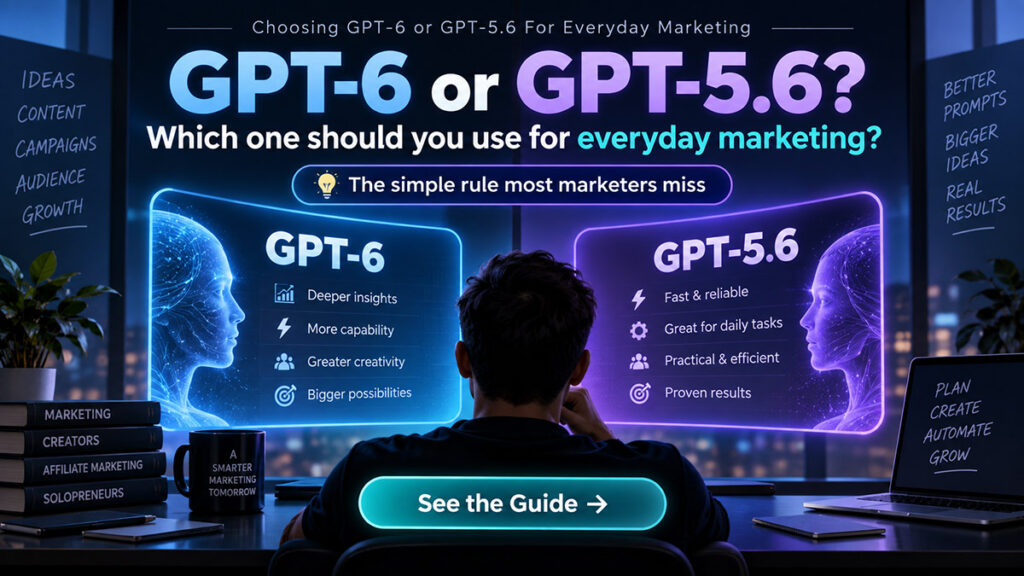
Choosing GPT-6 or GPT-5.6 for Everyday Marketing includes task-by-task starting points and examples of what to include in your briefs.
It also includer PLR rights - use it for list building or sell your own product!