What is Automation?
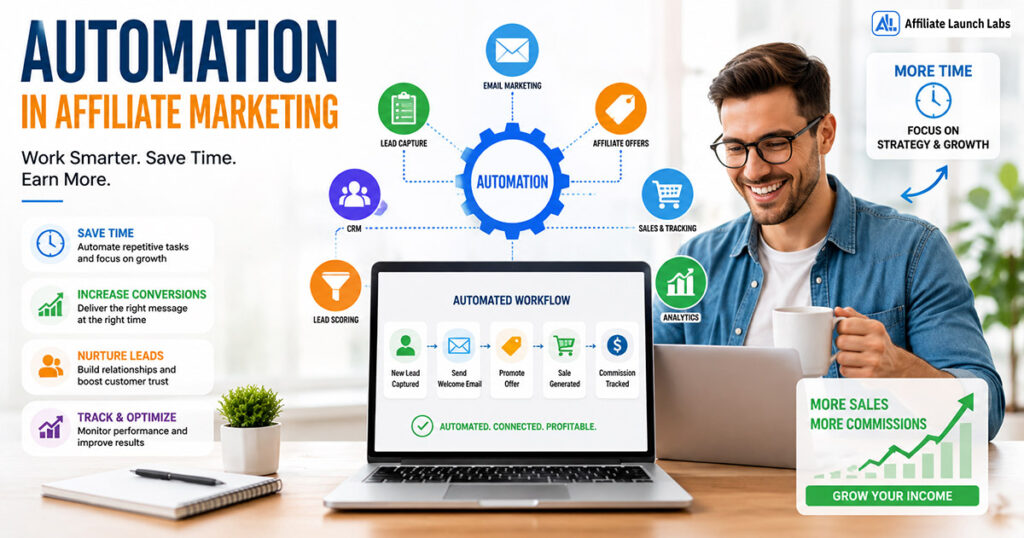
Simply put, automation is something that happens inside your workflow without you actually doing it yourself. There are a number of tasks everyone has to repeat daily, hourly, per certain task or depending on some events that happen. These helper taks take time, need your attention and can make you lose focus.
Affiliate marketing is a real business. As such, it requires certain processes to be in place which make the machine work, so to speak. One has to do everything regarding the marketing part, like finding products, creating offers and funnels, designing promotions. But there are a lot of mini tasks that have to be done in order for everything to really fit together. Introducing automation tools into the process can massively improve the effectiveness, giving you - as the owner - more time to use on more important things. Like fishing, for example. 🙂
Let's see some examples.
Automation: Use Cases & Examples
Let's assume a few things before starting, in order for the examples to make sense.
Every affiliate marketer has some assets and processes, and here are some we'll assume are in place:
- Autoresponders: One or more email lists, consisting of contact data of our leads and customers.
- Landing pages: Pages where we offer incentives for people to join our lists, or introduce offers we're promoting.
- Social networks: Multiple account on networks like Facebook, X and others will help us build an audience and promote offers.
This is just a gew of the basic things, we don't really want to go too deep into this.
Then, if we also have our own products to sell (which is a great way to earn online, by the way), there are some other basics that we need besides what was already mentioned.
- Sales pages: Pages where we introduce our own offers and sell them.
- Page Builders: Tools that help us create pages quickly and connect them to everything else without too much hassle (like Convertri, OptimizePress, etc).
- Payment processors: In order to sell something, one has to use one or more payment processors (like Paypal, Stripe, etc) or affiliate networks (like JVZoo, etc).
- Delivery systems: Pages or memberships where our customers can receive what they've purchased (like ProductDyno, etc).
But you're right, the complexity grows quickly. So let's just focus on some very simple automations in the affiliate part of the business, i.e. promoting other people's offers.
Example 1: You've made a sale
You were promoting a product from JVZoo, and you've made a sale. The commissions are in, and you're happy.
Your system includes tracking of any sales made, because you want to know where you stand, so you want to enter this sale into a Google Sheet as soon as possible.
You log in to your JVZoo account, find the sale. Then you open your browser and Google Sheets, find the right one and open it. Now you enter any relevant data you can into the sheet (like the offer name, date, sale and commission amount), which gives you a total for this year's achievement.
Additionally, if customer data is available for that specific offer (meaning the vendor and JVZoo will share customer data with you, which sometimes happen), you will open your Aweber account and add a new customer's data in your buyers list.
You've just used at least 15 minutes of your time, possibly breaking some other task that you were working on. Or, even worse, you're away from your computer and can't do it right now, which means adding this task to your to-do list.
Using simple automation: this could have happened automatically. The moment the sale was made, your Google Sheet could be updated. Even the customer data (if available through the network) could have been added to your Aweber list already. So you just see the notification, smile and nod, and keep doing whatever you were doing. Task done, no time or effort needed, 15 minutes saved.
Example 2: Someone joined your list
Through advertising, someone opted in for your lead magnet and joined your marketing list at Aweber. They're now tagged and ready to be marketed to using Aweber email sequences.
At the same time, you want your lead to join your webinar presentation - an evergreen webinar that you have created and which will run half an hour after the signup.
Let's be clear - this is practically impossible to achieve, unless you're glued to your computer 24/7. There will be delays much longer than a few hours, always. And it actually ruins your chances, because the lead is interested right now, who knows what they'll be thinking in the afternoon. But for the sake of this example, let's assume - again - that you manage to intercept the optin and go to work immediately after the sign up process is done.
You log in to your webinar software and add the name and email to your webinar.
Using simple automation: your lead could have been passed down to your webinar software and registered for the webinar just moments after the signup. Besides the time saved (ok, a couple of minutes in this case) and the fact that you practically have no chance of making it happen manually, you gain two things: you simply don't have to worry about it, which effectively frees your brain for other things, and you get the lead inside your webinar at perfect timing, which dramatically increases your chances of making a sale.
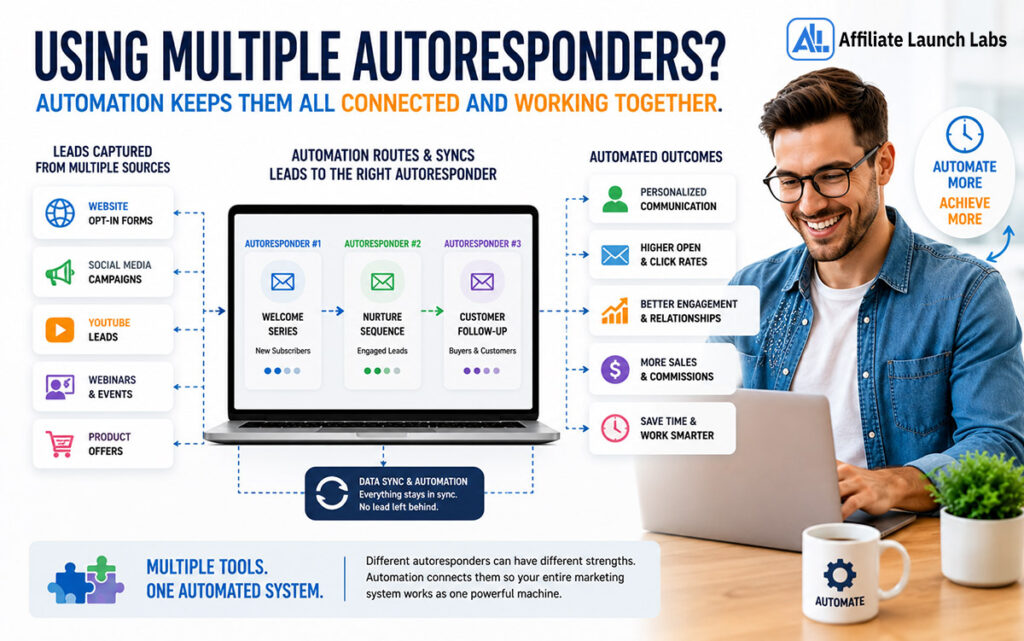
Example 3: You are using more than one autoresponder
In certain cases and completelly depending on your organisation, you might be using more than one autoresponder to handle your email marketing.
An example might be that you get a lead through your opt in page, but the lead also ticks your box and expresses a clear wish to act like your affiliate for some cases. In this case, you'll want to add them to your Aweber lead list, but also to an affiliate list. And here, you might want to use another autoresponder for any reason - maybe just the limits of your account or anything else.
I'm personally using Aweber and Sendiio for this particular reason, and in such a case I really want my affiliates to be handled by Sendiio, because it's quite separated from the general affiliate marketing email automations. Additionally, at Aweber, a subscriber in two lists count as two subscribers - and my direct monzhly cost depends on the number of subscribers I have on all my lists.
This example works both ways - is someone joins as an affiliate for a certain offer, they can also be considered a prospect that could by it.
What can be done is export the tagged leads from Aweber (tag: affiliate or something similar) into a .csv file and import it into Sendiio. This has to be done regularly, as new leads come in, or I'm again missing the opportunities. The process itself is fast, possibly 5-10 minutes. But it has to be done daily, as new leads come in, so this adds up to the other tasks on the list quickly.
Using simple automation: When someone joins your list on one autoresponder, your lead can be passed to any other autoresponder immediately, properly tagged and everything. Even more autoresponders, depending on your business model. It could all happen automatically, the moment the lead opted in, saving you additional minutes per day and freeing your mind from that problem completely.
Example 4: You're running a Facebook Lead Ads campaign
Facebook is a great place to gather leads, depending on your business, of course. The problem is the leads stay within Facebook - you can engage them further through Messenger and WhatsApp, but even that is limited. It would be much better if leads would also be added to your email list at Aweber or any other autoresponder where you can market to them for longer periods of time.
The process is pretty nasty to do manually (or at least it was when I last did it), but it includes exporting, which Facebook is not happy about, and importing, which autoresponders don't like sometimes. In any case, time and effort are needed.
Using simple automation: Leads gathered through Facebook Lead Ads can be automatically added to one or more autoresponders and properly tagged in the process. Now you can use all the power of email marketing to get them in your affiliate funnels and earn commissions for months to come. You don't just get your time back, you also get another marketing channel opened and the opportunity to get your ad spend back gets much more realistic.
How can automation help you?
The use cases mentioned above are just simple scenarios every affiliate marketer encounters daily. I'm pretty sure you can think of a few more in moments, not even having to draw another breath.
Here are some of the immediate effects of simple automations being introduced to your business model.
- Saving time: Every task that gets automated will get you some time back for other things.
- Focusing on important things: Not having to worry about how leads are organized, whether your webinar will be promoted to your leads in time and so on makes life much easier and raises anyone's ability to focus on things that grow your business.
- Business running without interruptions: Being able to introduce offers at the right time is crucial to be successful in marketing. If you miss the moment, the opportunity is gone for good - and leads are much more likely to spend money right after they expess interest (that is, they opt in, for instance) then after a day. They'll forget about you by that time.
- Business growing: By introducing your leads to various offers based on their interest, you create multiple opportunities to earn commissions from every lead.
How to introduce automation into your business
There are certain things that can be automated natively inside your apps and you probably already know about - and use, hopefully. Aweber Automations is an example - it's been renamed to Automations a while back, but it's really just a system that lets you create email sequences that start and run under certain conditions. So if a lead comes in via a certain channel, it gets tagged and according to the tag applied the proper email seqeunce fires that promotes a certain offer.
This enables you to create automated email series that go to each and every subscriber in the list (or segment), based on their activity (tags applied). It's great - you create a sequence, assign a tag that fires it, and then collect subscribers. Every subscriber will go through that same sequence, and hopefully spend something on the way.
That's part of it and one way to handle some automation.
The other, much more powerful and connecting many separated apps, is using specialized apps like Zapier, Pabbly Connect or Make.
While many apps have some internal automations available, the power of these specialized apps is that they actuall connect different apps. Like, if we take a look at Example 1 & 2 above, we're connecting a payment platform to a Google Sheet and an autoresponder to a webinar software. This is not possible inside Aweber, for instance, nor the rest of the autoresponders. So they open a whole new world of opportunities to automate your business.
The problem of these apps are the costs.
Zapier, Pabbly and Make all charge you by the number of tasks executed per month. The costs vary from $19/month for Pabbly's account with 10k tasks/month (limited functionality), and can easily pass $100/month, which means over $1,200/year. A task, in that context, is every operation that happens when a trigger is fired, so every non-basic workflow can consume tens of tasks easily.
The alternative
One of the alternatives - frankly, the best I've seen so far - is WP Sync.
First, it has a low pricing tag, presently even a one-time fee of up to $147 for the full package, bit even at $147/year it's 10x cheaper than anything else. There are no limits in tasks in WP Sync, so this is even more so.
Second, it's a WordPress plugin. While it may sound like a not-so-good feature, because cloud is more powerful (or so they say), it actually has a few powerful benefits. One of them surely is the fact that all data moving through it always remains at your own server, while every other app pass that same data through servers who knows where.
It has its limitations, though. Currently, it connects a little over 150 apps, which may seem low compared to Pabbly's 2,000. But one of the connectors is also a webhook, which practically represents the way apps talk to each other. So the actual number of apps is much higher.
WP Sync can easily fulfill all examples mentioned above. For most marketers who are not running 7-figure businesses, it's more than enough.
I seriously recommend taking a look, perhaps you'll even catch the one-time payment option still.

Conclusion: Automation in affiliate business
Whatever you're doing online and however you're running your affiliate marketing, simple automations can dramatically improve your success rate, as well as return some time back in your hands. I would seriously recommend thinking about it and introduce little steps into your business. Every ste will do you some good, you'll see, and soon you'll be thinking about including some more, for tasks you don't even realize you're doing all the time.
The best alternative to the big three (Zapier, Pabbly Connect, Make) I could find right now is WP Sync. Take a look at the supported apps and the demo, it just might be what you need in your business right now.
So - automation? Yes!