Affiliate Business is the best
While this statement is true for me personally, people often quit after a short time trying it. In fact, over 95% of affiliates quit after only a few months. The main reason is usually simple - no real results. When investments cross a certain border with no results to show, people start feeling played. But it doesn't have to be like that. In reality, a simple affiliate system could completely change this, and this is exactly why The ClickBank Profit Challenge was created as a perfect affiliate system.

Starting out
When I first met affiliate marketing, it looked unreal. How can people make millions (literally) by selling other people's products online? I started digging, and shortly after that I started buying courses, products, everything that promised me a good outcome. I've paid thousands for courses that made it look simple, only to learn that I have to learn it a bit differently, so I was "forced" to pay another course. Boy, was I green.
The most important thing I've learned since those days is that affiliate business is a real business. That it works as any other business. That I need an affiliate system in place to become at least somewhat successful.
I surely wish I've met something like The ClickBank Profit Challenge back then.
Affiliate Business: Common frustrations
People starting out almost always feel the same frustrations, originating directly from the fact that thay've started it ad hoc, without a clear strategy or system they could hold on to help them organize themselves.
Here are a few I've met myself. Check them and if you're able to find yourself in any of them, think abour checking The ClickBank Profit Challenge. It will change how you see affiliate business completely.
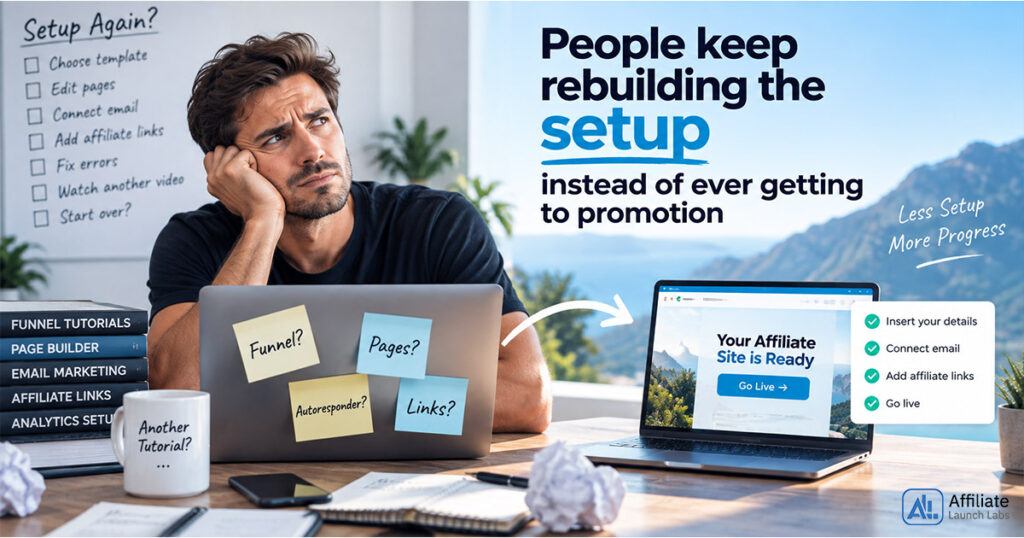
People keep rebuilding the “setup” instead of ever getting to promotion
What This Looks Like In Real Life
A likely recurring pattern is spending another evening watching a funnel tutorial, opening a page builder, choosing a template, changing headlines, wondering what pages they actually need, connecting an autoresponder, checking affiliate links, and trying to understand where everything is supposed to go. Usually something doesn't connect properly, or the tutorial they're following uses a different tool/version, so they go searching for another video.
A week later, they still haven't sent meaningful traffic anywhere. They've been “working on their affiliate business,” but most of that work has been preparing to start.
Why It Bothers Them So Much
There's no clean finish line. Every solved problem seems to reveal another technical decision.
More importantly, setup work produces almost no emotional reward when commissions are still sitting at zero. They can spend hours being productive without receiving any evidence that they're getting closer to making money.
Eventually, “I need to get this set up properly first” can start feeling suspiciously like the same excuse they've been making for months.
What They Really Want Instead
They want to open something that's essentially finished, insert the few things that make it theirs - such as their affiliate details and email integration - and be able to say:
“It's live. Now I just need to get people to it.”
Three Phrases They Keep Telling Themselves
“Why am I still setting this stuff up?”
“I just want something that's ready to promote.”
“I haven't even got to the traffic part yet.”
If you can relate to these, The ClickBank Profit Challenge will help you.

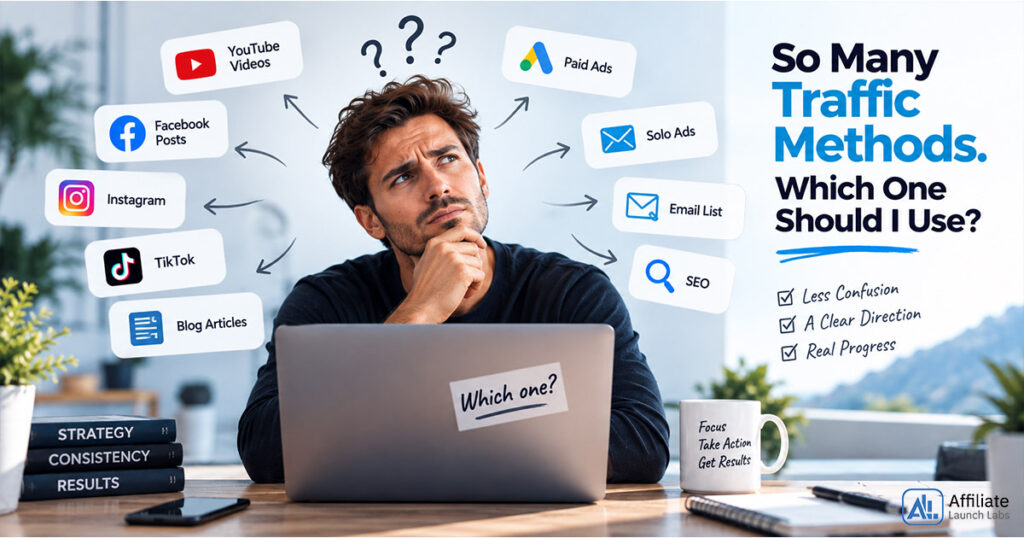
Every time they try to get traffic, they're forced to decide what method to try next
What This Looks Like In Real Life
They know they need visitors, but “get traffic” turns into an exhausting menu of possibilities.
Should they make YouTube videos? Start posting on Facebook? Build an Instagram account? Try TikTok? Write articles? Run paid ads? Use solo ads? Start an email list? Learn SEO?
They research one method, discover its drawbacks, then find someone claiming another method works faster. They spend time setting up an account or creating content, see little immediate response, and begin wondering whether they've chosen the wrong traffic source.
So instead of doing one traffic activity repeatedly enough to learn from it, they can get trapped in traffic-method hopping.
Why It Bothers Them So Much
Traffic is the part that ultimately determines whether the funnel gets seen, so choosing incorrectly feels expensive.
Someone who has already failed to make consistent ClickBank commissions may no longer trust their own judgment. Every new traffic decision carries baggage from the last thing that didn't work.
That turns a practical question—“Where should I promote this?”—into a much heavier one:
“Am I about to waste another month doing the wrong thing?”
What They Really Want Instead
They want someone credible to look at their starting position and narrow the choices down:
“Given what you have—your budget, experience, time and skills—start with this traffic method. Here's what to do first.”
They don't necessarily need every traffic strategy. They want to stop wondering which one they should be using.
Three Phrases They Keep Telling Themselves
“Which traffic method am I actually supposed to use?”
“I don't want to waste another month on this.”
“Every person tells me something different.”
People keep checking their ClickBank account for commissions that aren't there
What This Looks Like In Real Life
They've posted links, sent some traffic, perhaps created content or promoted an offer—and then comes the waiting.
They check their ClickBank dashboard.
Nothing.
Later, they check again.
Still nothing.
A click might appear without a sale, which creates a new round of questions: Was it the offer? The traffic? Their link? The landing page? Did they target the wrong people? Do they simply need more visitors?
Because there may be too little data to diagnose anything confidently, they're left staring at numbers that don't tell them what to fix.
Why It Bothers Them So Much
The dashboard becomes a scoreboard for whether all this effort is “working.”
Zero commissions isn't merely zero dollars. For someone who has repeatedly attempted affiliate marketing, it can feel like another piece of evidence that they're still no closer to figuring this out.
Even worse is the uncertainty. If they knew exactly what was broken, they could fix it. Instead, they can end up changing offers, traffic methods or pages almost at random.
What They Really Want Instead
They want a straightforward system where the important variables are clear: a working funnel, a defined traffic method, leads being captured, follow-up happening automatically, and enough visibility to know where the bottleneck is.
Most of all, they want that first concrete signal that the machine works: a lead, then a commission, followed by evidence they can repeat the process. Yes, ClickBank Profit Challenge will provide all of these.
Three Phrases They Keep Telling Themselves
“Still nothing.”
“What am I doing wrong?”
“I just need to know this actually works.”
People do all the hard work to generate a ClickBank sale, then lose the customer
What This Looks Like In Real Life
This is especially central to the offer's positioning.
They find an affiliate product, create content or promotions around it, persuade someone to click their affiliate link, and potentially generate a sale.
Then the relationship effectively ends.
The vendor collects the buyer's information and can continue marketing additional products to that customer. The affiliate receives the applicable commission but may have no owned email relationship with the person they worked to acquire.
So tomorrow, when they want another commission, they need another visitor.
And another.
And another.
Why It Bothers Them So Much
This makes affiliate marketing feel like a treadmill rather than an accumulating asset.
Even when something goes right, they may still feel as though they're returning to the starting line. The vendor's customer base compounds while theirs doesn't.
For someone who has already struggled with traffic, that's particularly painful: the hardest thing for them to obtain—the visitor—can disappear from their business after one interaction.
It also creates a deeper frustration around ownership. They may realize they're generating attention for somebody else's business without building much that they themselves control.
What They Really Want Instead
They want each successful traffic effort to leave something behind.
Even if a visitor doesn't immediately buy—or only buys one product—they want that person on their email list, where they can follow up, build a relationship and potentially promote relevant offers later.
The desired shift is from:
“I need another sale.”
to:
“I'm building an audience that can produce future sales too.”
Three Phrases They Keep Telling Themselves
“Why am I building the vendor's list?”
“Tomorrow I'm back at zero again.”
“I need to keep the leads I'm generating.”
People keep buying “the missing piece,” only to discover there's another missing piece behind it
What This Looks Like In Real Life
They buy an affiliate-marketing course because they need a system.
Then they discover they need a funnel.
They find funnel training but realize they need email follow-up.
Then comes traffic.
Then tracking.
Then copy.
Then automation.
Then another tool or training promising to simplify whichever piece they're currently stuck on.
Their computer can gradually fill with bookmarked trainings, downloaded PDFs, unfinished courses, login credentials and half-built campaigns—while the actual revenue-producing system remains incomplete.
This is a likely pattern worth validating through further VOC research rather than assuming it applies to every prospect.

Why It Bothers Them So Much
Each purchase initially creates relief: “Maybe this is the thing I was missing.”
When it instead introduces more tasks, tools or prerequisites, that relief turns into disappointment.
After enough cycles, skepticism grows. “Simple,” “beginner-friendly,” “done for you” and “step-by-step” become attractive precisely because this audience wants simplicity—but those same phrases can also trigger suspicion because they've heard similar promises before.
That's an important tension for the $9 challenge: low price reduces financial risk, but it doesn't eliminate their fear of wasting more time or entering another funnel that ultimately requires additional purchases.
What They Really Want Instead
They want fewer pieces, not another library of information.
Ideally, they want one functioning funnel they can actually deploy, one clearly recommended starting traffic strategy, follow-up already accounted for, and live guidance when something doesn't work.
The emotional payoff isn't simply “easy affiliate marketing.”
It's finally being able to stop collecting instructions and operate something that is actually live.
Three Phrases They Keep Telling Themselves
“I already have enough courses.”
“What else am I going to need to buy?”
“I just want to get one thing working.”
How The ClickBank Profit Challenge can help you
The ClickBank Profit Challenge is a 3-day live event, held by John & Alex Thornhill. I will not go into too many details, because you can see everything important on the sales page, let me just sum up some of the most important ones.
The Challenge shows people why building a list first gives them more control, why follow-up matters, and why a structured funnel can create more value than sending traffic straight to a single affiliate page. This gives affiliates, beginners, and stuck online marketers a clearer way to understand ClickBank.
But, even if it's targeted at ClickBank as the largest affiliate network, the principles are evergreen and valid for every affiliate network out there. The outcome of The Challenge though is a finished funnel that promotes a ClickBank offer that pays up to $300 in comiisions, hence the name and orientation.

The 3-Day Challenge Structure
The ClickBank Profit Challenge is built around three live days.
Day 1: Deployment
Day 1 focuses on the foundation. This includes list building, funnel thinking, and why capturing leads matters before sending people to offers.
Day 2: Traffic
Day 2 focuses on follow-up and how backend value can create more opportunities. This is where attendees begin to understand why one lead or customer can be worth more over time.
Day 3: Automation
Day 3 focuses on the wider ClickBank Profit Club system and how attendees can continue building beyond the live Challenge.
Challenge buyers receive access to the live 3-day event and the Challenge Hub.
The Challenge Hub is where buyers can access setup steps, updates, resources, and Challenge materials.
Known buyer resources include:
- Challenge Hub access
- live 3-day Challenge access
- setup instructions
- Affiliate DNA Quiz
- pre-challenge content
- Challenge reminders
- Challenge Workbook
- support information
- access to any purchased upgrades
The Challenge Workbook is designed to help attendees follow along during the live sessions and take action as they go.
The key points
- It Is Beginner Friendly: The Challenge is suitable for complete beginners and stuck affiliates who want a clearer plan.
- It Is Live: Attendees can join John and Alex live across three days.
- It Is Practical: The goal is to help people understand and build around a real funnel-based system.
- It Is Built Around List Building: The Challenge explains why building an email list matters and why affiliates should stop sending all traffic straight to vendor pages.
- It Shows A Better Affiliate Model: The Challenge introduces people to a model where leads, follow-up, and backend opportunities can create more value over time.
Conclusion
I don't want this ClickBank Profit Challenge review to read as one of those "it's perfect" posts. It is not perfect, of course. And it surely isn't a push-button-and-be-rich template. You will surely need to do your part of the work, but that's the whole point of any business, isn't it? The main outcome I see in the ClickBank Profit Challenge is that atendees will walk away with a finished affiliate funnel that will help them start building their lists and business. And learning how to do it in the process.
A few parts I've identified are missing for a beginner I've tried to repair with my custom built bonuses. They will cover the surrounding work without recreating the ready-made funnel you receive from The Challenge.
Another burst of information will not help if you keep starting over.
A lot of affiliates already know enough to open ClickBank, choose an offer, and copy a link. The problem is the broken sequence around it: no clear setup, no consistent traffic routine, no reliable follow-up, and no measured decision about what to do next.
A live implementation challenge will.
The ClickBank Profit Challenge gives that work a three-day order. Day 1 covers deployment, Day 2 covers traffic, and Day 3 covers automation. It is a live implementation event, not something to half-watch in the background. My nine bonuses support the preparation before it starts and the operating work that continues after it ends.
Start confidently with my Traffic Starter Kit.
As part of my custom built bonus for atendees, I will send 100 qualified clicks ($97 value) to your affiliate link or landing page when you're ready. They will come via my Pinterest traffic pool rotator. While I surely can't guarantee sales, it will make your offer move and help you start.
Don't forget the timeline!
The general admittance pricing goes from the initial $9 to $19 on Sep 14th, then $27 on Sep 21st, and finally to $39 just before closing on Sep 28th. The sooner you reserve your spot, the more you save.
You may also like
- What is Affiliate Marketing (and what it isn’t)
- Importance and Benefits of Automation in Affiliate Marketing
- What you absolutely need to know about traffic