Introduction
Most beginners approach affiliate marketing like a collection of random tactics: post a link, try a new traffic method, switch offers, repeat. The problem is that tactics don’t add up to progress unless you have a clear workflow that tells you what to do first, what to do next, and how to evaluate what happened. That’s what an affiliate launch system is—a repeatable process that turns “trying stuff” into measurable learning.
An affiliate launch isn’t a big event or a one-time push. It’s simply the moment you take one offer, one message, and one promotion plan and put it into the market so you can see real feedback. Sometimes that feedback is sales, but early on it’s often more basic: clicks, opt-ins, and whether your angle makes sense to the right people. The goal isn’t perfection; it’s completing the loop so you can improve.
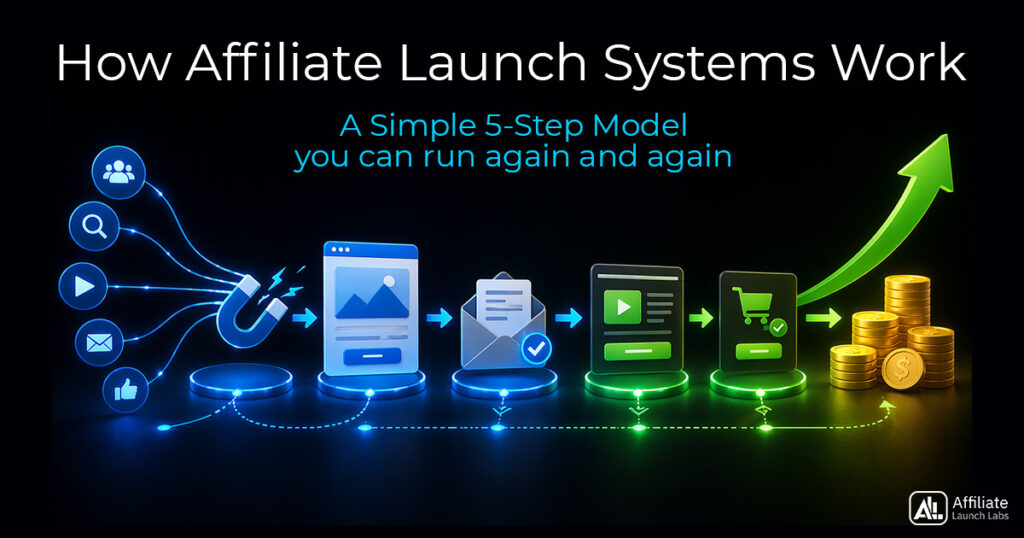
In this post, we’ll break down a simple launch system you can run again and again: how to choose an offer worth testing, how to frame it with a clear angle, how to set up a beginner-friendly funnel, how to drive traffic without spreading yourself thin, and how to track the few numbers that tell you what to fix next.
What is an affiliate launch
Simplified, it's what you do when starting the promotion of a certain product.
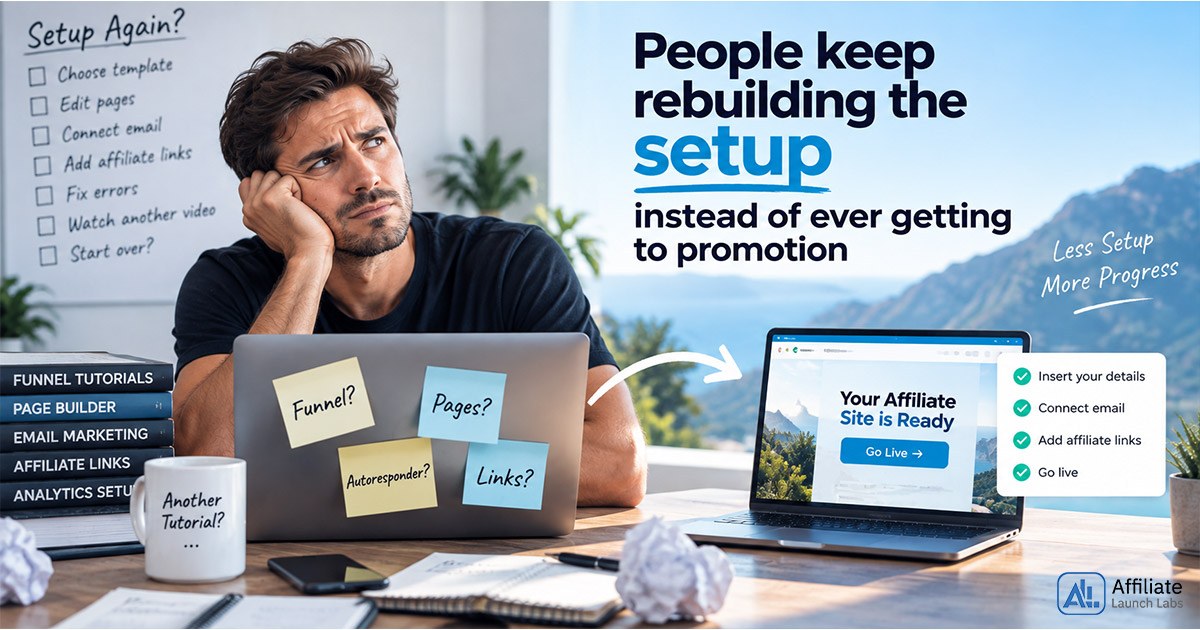
What beginners mostly do
The usual (expected) steps in this process are finding something to promote, organizing the traffic via different channels, and collecting commissions.
Beginners usually find something published on affiliate networks (like JVZoo, ClickBank, Warrior+, ...), grab a link and start writing a post about it somewhere, putting their link everywhere. Then, if they have a Facebook or X (Twitter) account, they post around from time to time about it.
Next week (or day even), once they see the poor results of their work, they go for another offer. Another post, maybe a bit different.
And so it goes, on and on, with the same poor results.
Somewhere between all those steps they're buying shiny tools that come to their email. A video creator, a social publishing tool, whatever - they all promise so much.
The outcome?
Unless they're really lucky, results are usually poor - if any at all.
The most visible result they see is their budget disappearing into the void. And most probably a rising anxiety, because nothing seems to work.
And so most of them quit.
What a shame. If only they knew better...
My own path
Yes, I've done all that. Which is extremely hard for me to confess.
I've worked all my life in software engineering, hardware development and maintenance. And one thing that seems absolutely clear about such work is that there has to be a systematic approach to each and every problem. There are clear guidelines what the steps should be in order to create or fix something. Not following them ALWAYS (without exception) leads to chaos, temporary solutions that cause problems further down the line, even system failures. And, of course, lots and lots of additional time, money and nervs to bring it all back together.
I honestly have no idea why I have assumed that affiliate marketing would be any different.
It's not.
It's all about the system.
What an “affiliate launch system” means
The simplest definition would be
A launch system is a repeatable set of steps you use to select an offer, choose a message, publish promotion assets, and track results - so you can improve instead of guessing.
An affiliate launch system is a repeatable workflow you use to promote an offer in a structured way.
The most important thing about it is that instead of guessing what to do next, you follow the same core steps each time: pick an offer worth testing, choose a clear angle, set up a simple path for the visitor, drive traffic, and measure what happens. The point isn’t to make every launch perfect—it’s to make every launch useful, because it produces feedback you can act on.
A clear launch system also keeps you from changing too many variables at once. When beginners jump between offers, niches, pages, and traffic sources every few days, they never learn what actually caused results. A launch system gives you a stable process so you can isolate what’s working, fix what isn’t, and build confidence through repetition.
Why systems beat tactics
Tactics are individual moves like “post on TikTok,” “run an ad,” “write a review,” “direct link to the sales page.” They can work, but they’re incomplete on their own. Without a system, tactics tend to create scattered effort: you do a lot, but you can never tell for sure what moved the needle, and you don’t build any momentum.
Launch systems beat tactics because they’re designed around outcomes and feedback. A system is built to answers practical questions that simple tactics completelly ignore:
- Which offer should I promote?
- What exactly should I say?
- Where do I send people first?
- What do I track?
- What do I change if it doesn’t work?
Only when you have those answers, your tactics become tools you plug into the process instead of random experiments.
The biggest benefit inside a launch system is consistency. When you run the same launch system loop repeatedly, you get better at the fundamentals: choosing offers that fit an audience, writing clearer hooks, building simple pre-sell pages, and reading basic metrics. Over time, that’s what turns affiliate marketing from a one-off attempt into a predictable skill.
The 5-phase Launch System
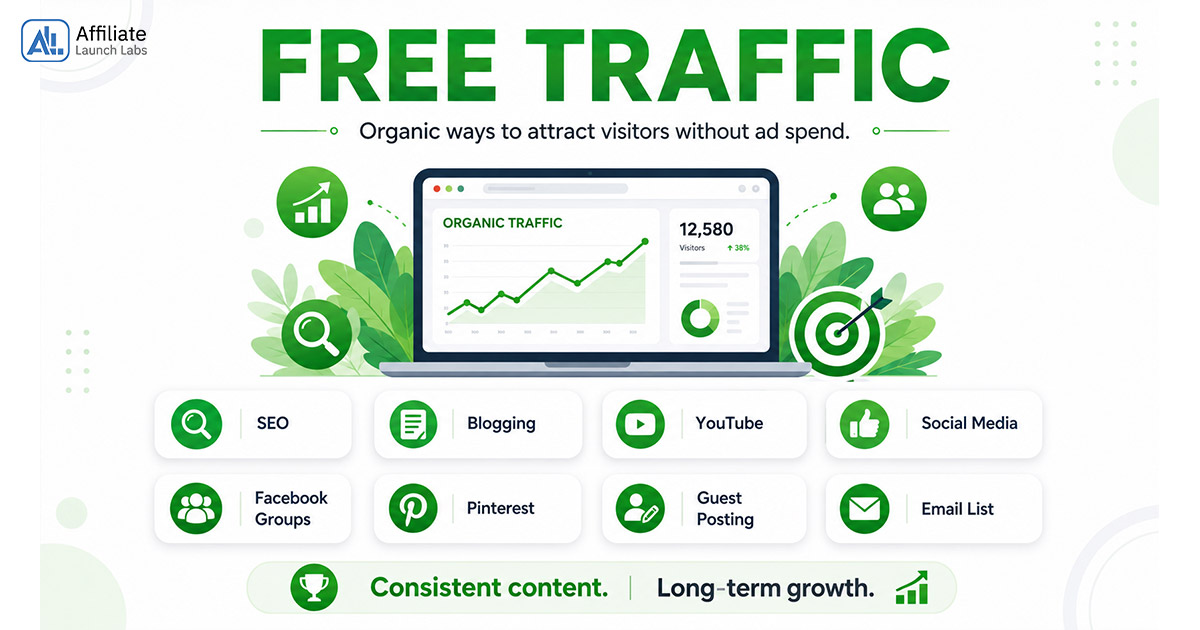
A good launch system is simple enough to repeat, yet structured enough to prevent guesswork. The five phases I'm describing below are the backbone. You can run them with free traffic or paid traffic, with a basic website or a more advanced setup. The details may change, but the sequence stays the same.
- Phase 1: Offer Selection
- Phase 2: Audience + Angle
- Phase 3: Funnel Setup
- Phase 4: Traffic Execution
- Phase 5: Tracking + Iteration
If you miss any of the phases, you're bound to hit problems somewhere in the process. You'll either repeat the error and start all over too soon, without proper data to back it up, or you'll have troubles executing the correct traffic flow to the offer. In many cases, while every other step is done, if the last step (tracking + iteration) is done poorly, you simply won't be able to decide upon what works and what's a flop. Which leads to problems when trying to scale, or burning money to push the things that don't really work for you.
Want to know more?
The “Launch Loop”
A launch system becomes powerful when you run it as a loop, not a one-time project. Most affiliates don’t fail because they chose the “wrong” niche or missed some secret tactic - they fail because they never build momentum. The launch loop is a simple weekly cadence that keeps you moving, keeps the variables of the system under control, and produces consistent feedback through tracking and conversions.
Think of it like this: one week is one clean test. You shouldn't try to publish everything, promote everywhere, and redesign your funnel at the same time. Instead, you’re running a focused cycle - plan, publish, promote, review - then improving the next loop based on what you learned. This is what makes an affiliate launch system so powerful.
A simple weekly cadence (beginner-friendly)
A simple weekly cadence with the tasks clearly defined can save you a lot of troubles, time and money.
It's based on 30 - 60 minutes of daily work, and it will give you very useful data about the way to go.
It's clearly described and defined insite a free book you can download HERE.
The whole point of this is to be clear on the offer you're promoting. And you start the next week with a slightly better version, and by the end of the week you'll again go through the same loop, slowly improving your results.
Why this loop works
The loop works because it makes learning inevitable. When you repeat a consistent weekly cycle, you stop relying on motivation and start relying on process. You also avoid the most common beginner trap: changing too many variables at once. Over a few loops, you’ll develop a feel for what “good” looks like - good offers, good angles, good hooks, and good traffic fit - because you’re actually collecting evidence, not opinions.
If you want the fastest way to make this practical, run the Launch Loop with a simple rule for the first month: one offer, one angle, one traffic channel. Your goal is not to be everywhere - it’s to get one system working end-to-end, then improve it. It's a core part of any affiliate launch system.
Pro Tip
A really good and inexpensive way to learn the system is to join The ClickBank Profit Club - a free membership that will teach you the system using proven examples and data.
Download the free book to learn more
You can download the free ebook Why Affiliate Launch Systems Actually Work where we discuss these topics in detail, along with some more advanced topics like
- The minimum viable affiliate launch: The essentials you'll need to make your affiliate launch successful, and the things that you don't need but will take you lots of time and possibly money. Clear description of two possible launch paths and why you should choose one or the other.
- Choosing your first offer and angle: What offer to choose for your first affiliate launch and how to find it.
- The assets that do the work: The assets you need to build or create that will make your affiliate campaign successful and scalable.
- Tracking: Tracking is what turns affiliate marketing into a learnable skill and gives you tools you need to scale the business beyond one-day campaigns.
- Common mistakes: learn about the common mistakes affiliates make and how launch systems prevent them before they happen.

See also
- What is Affiliate Marketing (and what it isn’t)
- The obvious Affiliate Marketing Pros and Cons
- Download the free 2026 ClickBank Profit Map
Frequently asked questions
Can anybody start affiliate marketing?
Yes. There are opportunities around the web that give you resources to promote.
Do I need any special skills to start affiliate marketing?
Not really. You need to master the basic computer skills, mostly. But since Affiliate marketing is a business, you'll need to learn some basics about marketing and establish a system that will make it easier for you. One of the first steps I usually recommend is find a community where you can start learning. One of the best is The ClickBank Profit Club (completely FREE to join), which focuses on ClickBank affiliate marketing. Besides the training and resources you'll also gain a good product to promote and start earning from the very first steps.