What is traffic?
Traffic, in its most simple sense, is measured by the number of visits your pages receive in a certain amount of time. It shows you how many people visited your page, no matter the content - it can be a landing page you're targeting via ads, a blog post page, an ad for your services, whatever. It is very closely related to conversions, which I'll talk about separately. Together, they form a metric that you as a marketer can use to see how much you are earning from your efforts.
And of course improve it over time, which is why every marketer should know about traffic as much as they can.
Why is traffic important?
Imagine a beautiful store in a beautiful city, where staff is nice, there are flowers, it smells fantastic. The moment people step in, they want to buy something.
So the store is doing great, isn't it?
The crucial part of the above statement is "the moment people step in".
Because, logically, you have to step into the store in order to feel that immense need to buy something. And the shop is doing great, as long as people step inside. If nobody enters, the business goes quiet and slowly dies. Every time, without exceptions.
This is what we call traffic.
The same logic is true for any kind of online store, site, page. If nobody sees it, it really does not matter how nice it looks, because nobody will ever buy anything.
Types of traffic
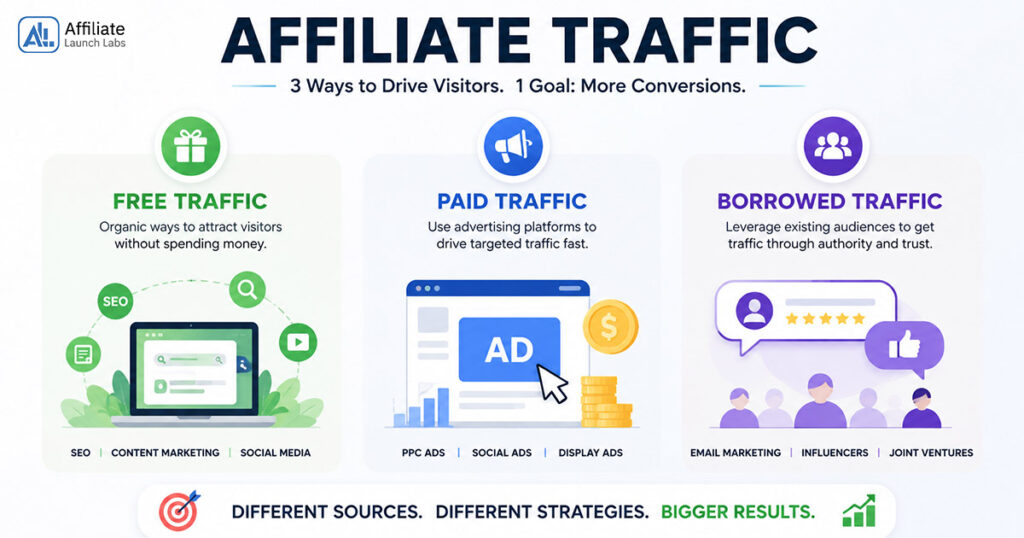
Basically, there are three types of traffic we'll talk about.
- Free traffic
- Paid traffic
- Borrowed traffic
Each type has its perks and regarding the offer itself, as well as the wanted results, one could be better suited than others. Meaning, we'll get better results using it, whether it's sales or optins we count as results.
So let's say a few works about each type of traffic.
Free traffic
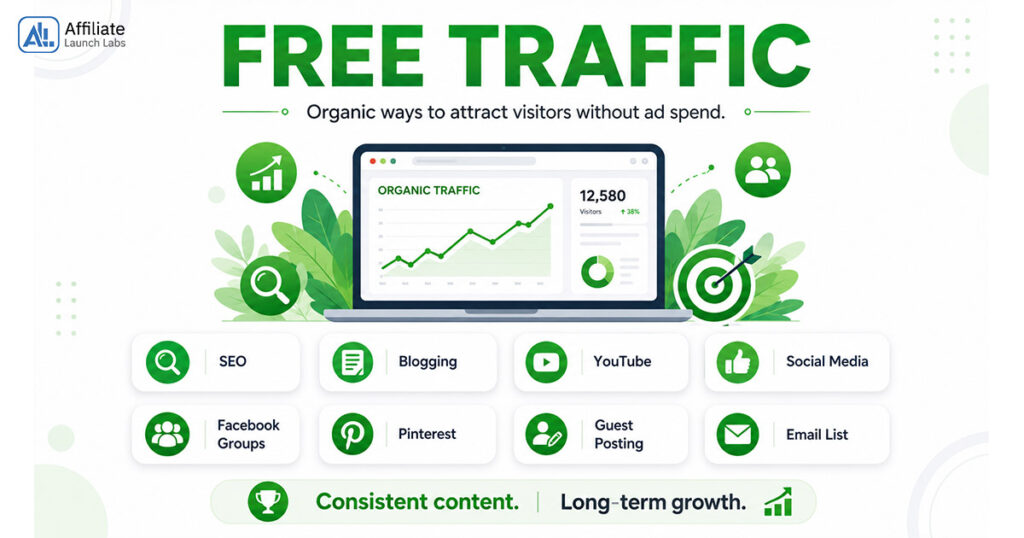
What we call free traffic is a result of something we did not pay for. Usually, this includes using free tools such as social accounts (Facebook, X, YouTube, ...) or blogging.
Caution: The term "did not pay for" can be misleading, as there's no such thing as a free lunch. We pay for everything, either with money or time. So the less dollars you spend, the more hours you'll use. Depending on your status and preferences, this can also be a deciding factor when choosing what type of traffic to go for.
Social networks
Social networks all work more or less the same way. They let you create a free account and post content, with regards to certain rules and limits.
The most known social networks such as Facebook, Instagram, X and YouTube all accept your posts anytime you're ready to write (or record) them. By posting and keeping a certain image of yourself, you can build a following - a crowd that is interested in what you post. In theory, they will see all your posts. Unfortunatelly, it's not the case, as certain filters and algorithms take over, so the usual rate is much lower today. They can then interact with your posts, communicate with you and click the links you provide, creating traffic to your landing pages.
Pros
- Social traffic is free, it costs you nothing
- It is fast, because people usually see your posts as they scroll
- It is simple to create interesting content, especially if you choose a niche you know a lot about
Cons
- While it costs no money, it will take you a lot of time
- Your posts are left to the algoriytm to decide whether to show it or not - you actually never know who will see it
- The content you create can quickly become obsolete
- It takes a lot of effort to create interesting ideas in a long term
Social networks are usually best used to build a following, which is actually your audience. If done right, in a group for instance, it can be a powerful image building machine and source of traffic to your landing pages.
Blogging
Blogging can be a much more targeted way to get free traffic. When you pick your niche, you can create a blog using WordPress (or any other platform) and start posting about a specific topic. Using common sense and SEO (Search Engine Optimization) rules your posts will start to attract people that are interested in your topic. As they come to read the post, you will have an opportunity to offer them something - a free gift in exchange for an email, a product, your service. The more knowledge and system you show in your posts, the more visitors will come.
Unfortunatelly, it's not all shiny. There are rules that you need to know if you want Google to show your pages to the public, and there are even more tools if you want AI systems to pick your posts as recommendations to people asking.
Pros
- Easy to start
- A lot of room to create content about any niche topic
- Your data, so unless you do something illegal, you're safe and nonody can cancel your account (compared to social networks)
- No costs upfront
- The traffic compounds when search engines pick it up
Cons
- Slow - it can take weeks for Google to index your posts, and you can't really push it yourself
- Requires good knowledge about the chosen topic
- Requires a lot of discipline and perserverance to get best results
- You have to have at least the basic knowledge of the system used (WordPress, etc...)
When you decide to create a blog, you better have a plan ready before you start. It will take some effort to get everything ready (the platform, the content plan, etc) and possibly incur some modest costs, because you will likely have to buy some essential tools at some point - plugins maybe, or services.
Paid traffic
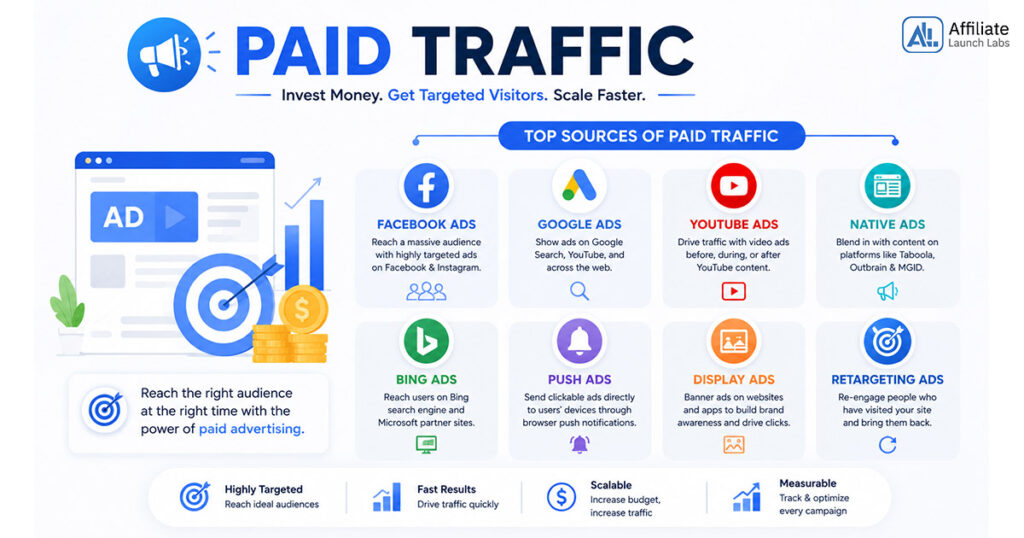
Paid traffic, in short, is any kind of advertising.
This includes Facebook and Google ads, as well as any other form where you pay and receive a certain amount of traffic to your landing pages.
A special type of paid traffic is called solo ads, where people with huge email lists let you define the targets and then send their contacts to your landing pages. As examples, TrafficZest and Udimi are great portals where you can get quality traffic to anywhere you want. Typically, you can define the target, the email you want them to send, and the amount you're willing to pay. The clicks you get can cost anything from $0.30, which is usually much cheaper than Facebook or Google ads, mostly because these clicks are much more targeted. Plus, you don't have to learn the complicated advertising platforms. 🙂
Additionally, should you consider joining through my links, you're getting a bonus in a form of a credit note, plus you can also get into their affiliate program and promote it yourself. So here are the links again: TrafficZest, Udimi.
Pros
- It's fast - usually takes hours (or less) to start receiving clicks
- It's predictable - you'll know exactly when and how many clicks will come
- It's targeted
Cons
- Can be expensive, especially if you get your ads data wrong (specific targeting)
- Requires control over ad spend
- Requires some testing to see which sellers perform best
In general, paid traffic is the best type of traffic when you need results fast - either it's for list building, product or service promotions, or some other goal. Traffic starts coming in very fast, sometimes within the hour, which also makes it perfect for split testing.
In the case of solo ads (at least for TrafficZest and Udimi which I'm using a lot), there are predictable conversion rates, something Facebook or Google ads can hardly give you. This helps enormously when planning the campaign, because you'll roughly know how many sales and/or optins you can expect for a certain dollar amount. Of course it always depends on your landing page quality, but optin rates - for instance - I've got from TrafficZest were usually above 35%, bringing my cost per conversion down significantly.
Borrowed traffic
When you start running an affiliate business and learning what you want to know about traffic, you can't ignore something called borrowed traffic.
You see, one of the important parts of affiliate business is networking - connecting to like-minded people around the globe. And when you have such connections, you can find people interested in traffic too.
The basic idea is to provide traffic to someone, while they are providing traffic for you, and you both use your specific assets to do that.
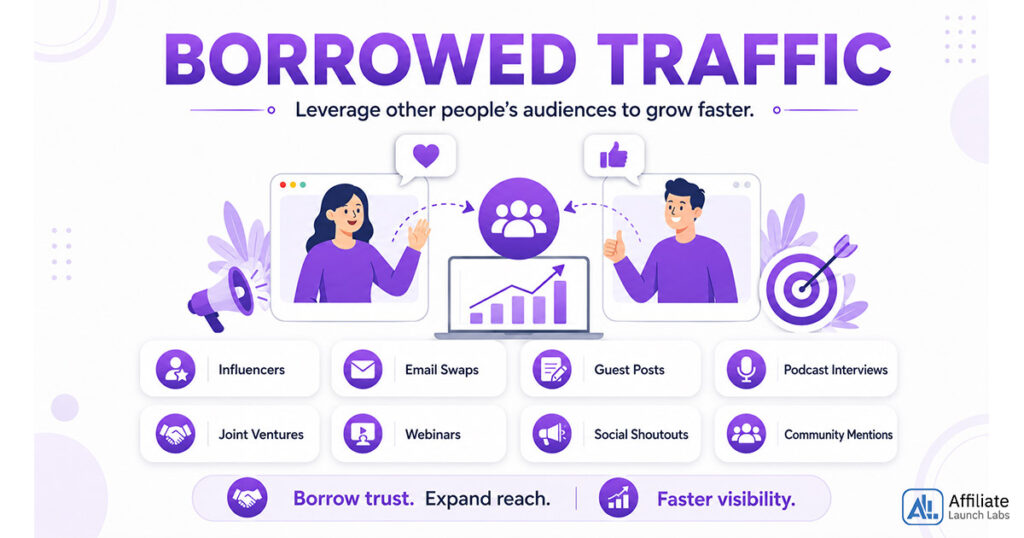
Marketers have their own audiences; one is more engaged on social networks and have a big following in a specific group, the other one has a big email list, and so on. No matter who you are in this equation, you'll easily find someone on the other side. The idea is to promote their link to your audience, while they promote your link to their audience. It's a matter of an agreement and usually works well for both parties, provided they work in the similar niche.
The other option are guest posts.
You can get someone with a blog to allow you to post your specific post, including your links. This way, you expand your reach and get new people to your landing pages that have the potential to become your buyers. This usually costs something, either payable in money or maybe a counter-offer, so letting them post their own post on your blog or social account.
Pros
- You get your offer promoted to a very targeted group of people interested in your topic
- It's free, because it uses existing resources. it only costs you to provide the service back as agreed
- Your blog - or social account - usually gets better, because a different view about something means a different sygnal to SERPs
- Your blog also gets backlinks, which is always a good sygnal to SERPs like Google
Cons
- If used as guest-posting, it's actually a form of free traffic (blogging) and therefore not fast
- You have to do your homework - getting connections in the same niche
- You'll need to create content that will be good and acceptable to the other party
What else is there to know about traffic
Believe me, this post barely scratched the physics of traffic science. There are so many fine details all over the wall that a single post could never cover them. Which is why I honestly recommend other resources, such as free membership sites created by proven professional marketers, to learn the ins and outs and start getting your business to work for you.
Depending on your targets, I'd like to mention two resources here. Both are free to join, and are targeting a but different needs.
Master Affiliate Profits
Master Affiliate Profits (MAP) is a free membership that focuses on general affiliate knowledge. Besides traffic mastermind, it includes list building, product creation and many other useful trainings. Some more pro-level based trainings will require you to upgrade to a paid membership, but you can easily start with a free level and start learning.
Check this post to learn more about the MAP ecosystem.
ClickBank Profit Club
The ClickBank Profit Club (CBPC), as the name suggests, is more targeted to running a ClickBank affiliate business. ClickBank is one of the largest affiliate networks out there, and it serves around 300,000 sales every day. It has certain specifics, which are presented in detail inside the ClickBank Profit Club trainings.
It also starts with a free membership and offers certain level upgrades, but you can decide about them once you decide you want to know more.
Both memberships include a special offer right after you join, a specialized traffic training that is available for a very low price (I believe it's $7). If you're primarily interested in learning about traffic hacks, I really recommend you grab it, no matter which membership you choose. It's not the same training, but both are presented by pro-level marketers and are a really good start.
Conclusion
Traffic is both the bloodline of every business and the major pain for every marketer.
The bloodline because there is no business without customers.
The pain because it has so many subtle variations that pro marketers never really quit learning about it.
In any case, it's something we all need in order to succeed with our offers, and there's no way around it. You either pay a lot, or you spend a lot of time working. Whichever resource you have more, use it.