The basics
We've all heard of the term affiliate marketing. And we've all heard about some people making crazy money doing it. And most of us who spend our days online have said "I'll get into this one day, and earn enough to quit my job". Not everyone asks what affiliate marketing really is, though.
It's not a hack, nor a shortcut to wealth. It's much closer to learning a practical skill set that you do every day. Because of this it takes some time and effort to start, so don't even read if you're not ready to put in some hours of your time.
In its most successful form, the one top affiliates that earn millions use, it's actually a full-featured business. And as any business, it takes time and money to operate it. But before it all, it takes dedication, organization and discipline.
Not everyone is ready to take it that far. Most of us just want another income stream that would help us get through the month and maybe fulfill some wild dreams. It's ok. No matter which level is your target, affiliate marketing is a legit thing.
What Affiliate Marketing is
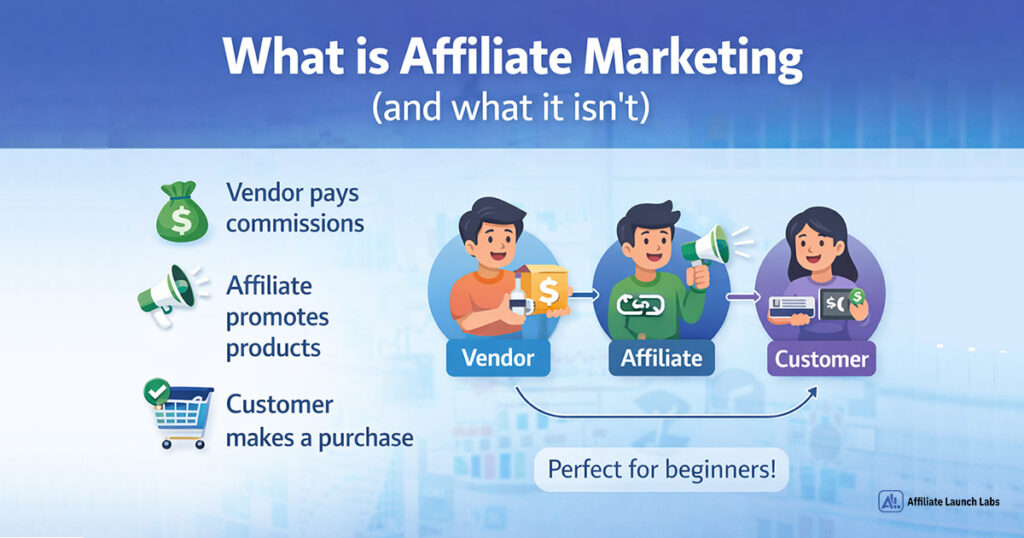
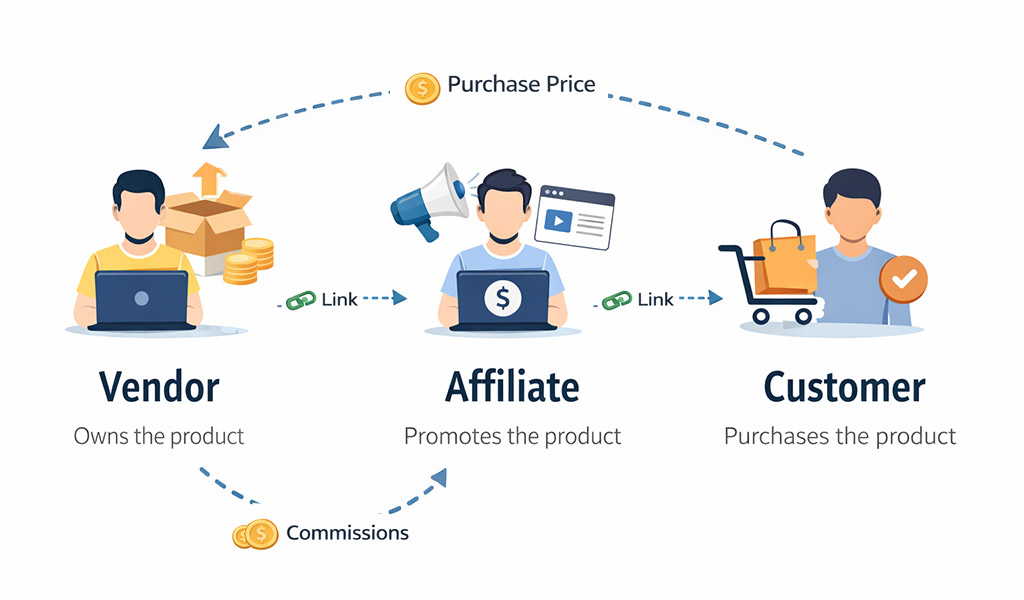
Affiliate marketing is a performance-based marketing model. Some company sells a product (vendor), and independent publishers (affiliates) promote it. If an affiliate’s recommendation leads to a sale (or another tracked action depending on the vendor's goals), the affiliate earns a commission.
That’s the core of affiliate marketing: you’re not “getting paid for posting,” you’re getting paid for results you can measure.
Because of that, affiliate marketing isn’t a hack or a shortcut - it’s closer to learning a practical skill set. You’re making decisions about what to promote, how to explain it clearly, and where to find people who already want that solution. The work looks like research, writing or creating simple ads, building trust before the click, and improving what you publish over time.
If you’re evaluating this as an opportunity, please remember that the correct expectation is steady progress, not instant wins. You’ll need to test ideas, track what happens, and adjust based on real feedback. Some campaigns won’t work at first, and that’s normal. The affiliates who stick with it tend to treat it like a system: choose an offer, match it to an audience, promote consistently, measure outcomes, and keep refining.
That's why it's a system, and that's why anyone attempting it really should take it as such.
Affiliate Marketing in a sentence
Based on what I've written above, one can easily push the whole affiliate marketing description in one sentence.
Affiliate marketing is when you recommend a product, and you earn a commission when your recommendation leads to a sale (or another tracked action).
The three parties
There are three parties involved in this process.
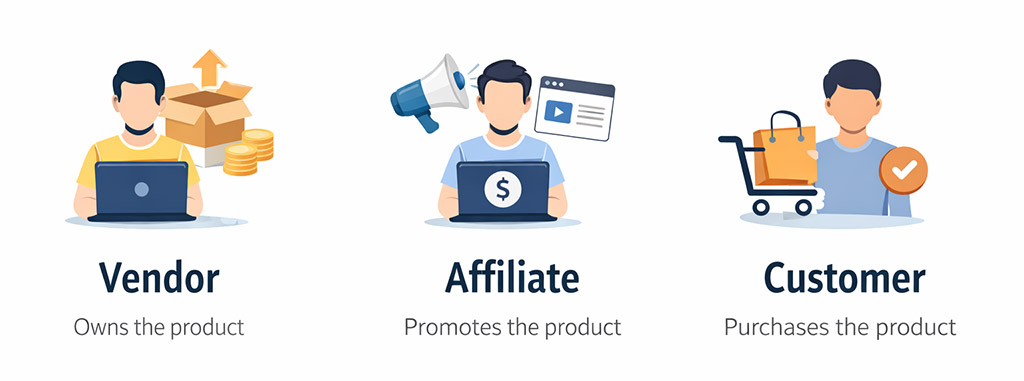
- Merchant or Vendor (who owns the product)
- Affiliate (you, promoting the product)
- Customer (pays for the product)
A vendor is someone putting the product for sale; it can be an individual or a company, usually as part of an affiliate network (Warrior+, JVZoo, ClickBank, ...), that sell their own products, or it can be a company that acts like a marketplace (Amazon, Etsy, ...).
Affiliates promote these products in order to close sales or achieve other goals, defined by the vendor - beside sales, they could also pay for contacts that affiliates bring to them.
Customers are people that buy these products. Ideally, they are part of affiliate's audience - maybe they are on an email list or part of specific Facebook group where the affiliate has direct access to them.
Is it a real business?
Affiliate marketing is definitelly a very real business. Especially if you want to be successful and create a serious income for yourself.
Let's be brutally clear on something.
If you approach affiliate marketing as a hobby, doing a post here and there on your social networks, you should expect hobby results. And we all know hobbies cost money, right? So while it may be fun, it's not going to replace your job. Like ever. It just doesn't work that way and you might be better off going fishing.
Affiliate marketing has to be approached as a real business. And every business requires organization, dedication and input, in the form of time and/or money. Only this way one can expect to get real results beyond a dollar earned here and there.
Is affiliate marketing legit?
It's actually a standard performance marketing used by companies for decades. In fact, everything you see in any shop is sold by this principle. Not to mention Amazon and AliExpress, for instance.
Unfortunately, it's also used by scammers as a label for their bad business.
Proper affiliate offers have - at the very least - these three main things in common:
Real products + Transparent terms + Measurable performance
And here's a short (and hardly complete) legitimacy checklist for offers and courses.
- Clear product owner and support contact
- Realistic claims
- Transparent pricing
- Refund policy easy to find and terms well specified
- No false pressure tactics like "You have 10 minutes to decide or else...."
If you want to check how to select winning offers on ClickBank, click below.
► Download the ClickBank 5-Point Hot Offer Checklist
What affiliates really do
Affiliate marketing is a business. And running a business takes time, dedication and proper organization. What affiliates do is not clear to everyone thinking about it. Every successful affiliate marketer follows some sort of a system, which can be summarized in the following list.
The day-to-day activities
Here are some of the steps every successful affiliate has to do almost every day.
- Choose products to promote (research)
- Understand the buyer and the problem the product solves (positioning)
- Create content or ads that match buyer intent and bring buyers to the offer itself (traffic)
- Pre-sell the offer (build trust before the click)
- Tracj results and improve (iteration and repeatability)
These steps are all part of a system that one simply has to have in place in order to operate (and earn!) on a larger scale. With any of the steps missing one can easily end up spending money instead of earning - a Facebook ad that targets the wrong audience is a guaranteed looser, for instance, because Facebook will gladly take your money for clicks, but the offer you're promoting will not make you any commissions. You're effectively spending money for nothing.
The simplest affiliate marketing funnel
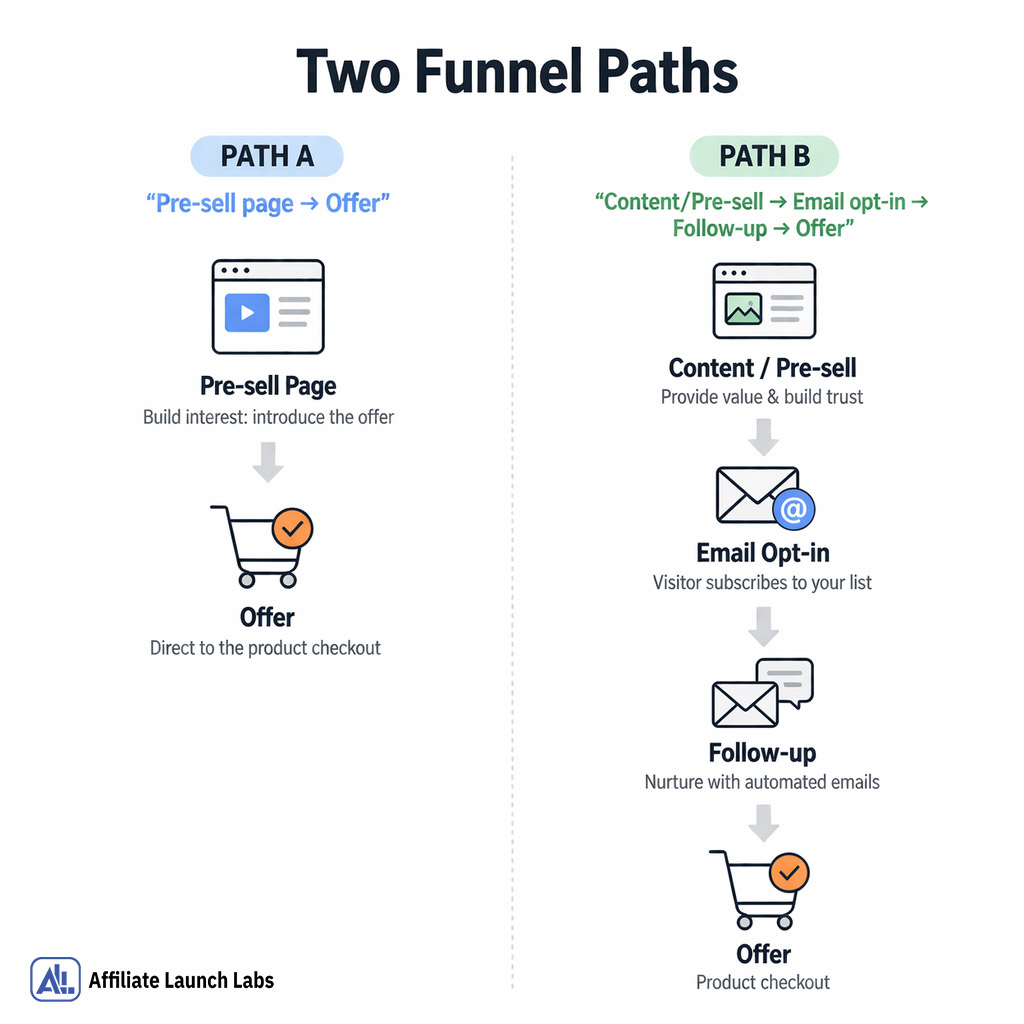
The process of bringing visitors to a landing page, possibly taking their contact details and then forwarding them to an actual affiliate offer is called a marketing funnel. There are two common paths to make that work.
Path A (easy)
A marketing funnel can be simplified to look like this.
Pre-sell page → Offer
The Pre-sell page is the landing page. It serves to convey a short pre-sell information to the visitor, such as a short list of the offer's most important benefits.
The pre-sell page leads (via a link or a button) directly to the offer page where the vendor actually does the selling.
Path B (recommended)
The recommended way to build a simple marketing funnel goes like this.
Content/Pre-sell → Email opt-in → Follow-up → Offer
The Content/Pre-sell page is your landing page where network traffic lands. As above, this is the web address you have defined in your tracking link.
This page should ideally have an opt-in form included where you can collect user's contact details (email). The reason for this is explained elsewhere, where I write about building an email list.
Follow-up is the process where your autoresponder goes to work, mailing people about the offer you're promoting, using a link you've received from the vendor. This is where you build a relation with your prospects and earn trust needed to convince them to visit the offer page.
Offer is the vendor's sales page where the sales are actually made.
Comparing the paths
The outcome these two paths ideally give is a sale and a commission earned.
The system one builds with them is however a different beast.
With Path A, you'll have very little work to start the marketing funnel and you can do it in mere minutes, actually. It is a good path for direct affiliate marketing. The bad thing is you're completely dependant on the traffic you bring in, because each visitor will see the landing page just once, and there's no saying whether they'll click and continue to the offer page at all.
With Path B chosen, which is a recommended way, you'll have a little more work in order to get things working. You'll also need some additional tools - an autoresponder that you'll use to build a database of contact details of your visitors, which is called an email list. In order to automate the process, you'll have to create an email sequence that will be sent to each registered visitor, inviting them to click your link and visit the offer page.
The most important difference between the paths is that with Path B you're building yourself an asset - an email list that you can use to mail your prospects again and again. This makes it much more valuabla to you, as you can mail them also other offers, therefore multiplying your reach and - hopefully - income.
What affiliate marketing IS NOT
Really - the one things you must do is be honest to yourself. Too many people get to affiliate marketing as if it was some sort of magic that would provide thousands of dollars on command. Be smart and don't fall for that.
There's no such thing as magic buttons.
Affiliate marketing IS NOT
- Easy money
- Post-a-link-and-get-paid scheme
- A business you control
- Building a brand (although it can support it)
It's not easy money
There's no such thing as magic buttons. Results will always come from successfuly matching offers to the right audience (people) and consistency in promotion. Most failures come from one (or more) of these errors:
- poor offer choice,
- inconsistent traffic,
- no tracking.
It's not post-a-link-and-get-paid scheme
You can apply to be an affiliate, get your affiliate link and start posting it around your social networks. You'll be dissapointed because the results will be poor, if any. It just does not work this way. Direct linking struggles because
- there's no trust built - why should people click your link?
- there's no follow-up - people don't usually buy on firts sight
- you are targeting the wrong audience, because 10,000 followers on Facebook does not mean they're all interested in the same thing.
It's not a business you control
While it may look like you're in control, think again.
You're not the product owner. If th vendor decides for whatever reason to stop selling the product, you're out. If they change the conditions, you can only adapt. Even the platform the product is sold at (Warrior+, JVZoo, ClickBank,...) can change rules and conditions over night, and you're out - or you have to adapt heavily.
In short, there are many factors that can ruin your campaigns before they even get off the ground properly. The only thing you're in control of is traffic and the way you promote it - advertising, blogging, etc.
You're not in control of this business.
It's not building a brand
Affiliate marketing is a relatively poor choice if you want to buid a brand. Sure, you can brand yourself as a new/great/special affiliate marketer, but that's more or less that. Every successful brand you can think of has its own products, be it software, physical products or services.
Affiliate marketing can help you create a brand, though, because nothing is stopping you from promoting someone else's products as a part of your own offers, effectively widening your reach and area of operation.
The main ways affiliates get traffic
Traffic (the people visiting your pages and clicking your links) is the bloodline of online business. In fact, the same goes for every business, because no matter how beautiful your shop is, no visitors means no sales and no earnings.
It is important to choose the right type of traffic when you're starting, because some are simply more suitable for beginners without large budgets.
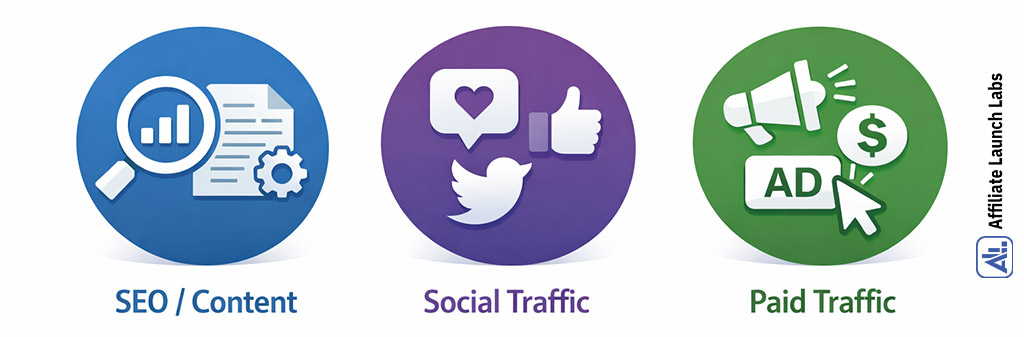
There are basically three main ways to get traffic.
SEO/Content (slow, compounding)
This means building some sort of content, whether it's blogging or social posts. This kind of traffic is slow, because internet takes its time, but it's actually best for authority and long-term traffic. This requires patience and writing discipline.
The SEO traffic, generated from your content, is generally the best traffic you can get. While it takes some time and a lot of content, it quickly coumpounds.
Social traffic (fast feedback)
We all have our accounts on Facebook, X, Pinterest and so on. One can use these accounts to share information about offers and post their affiliate links. This kind of traffic gives very fast feedback (in the form of likes and shares), but requires consistency and proper positioning.
Paid ads (fast but risky)
Paid ads are the fastest traffic you can get. It can get expensive though, especially if you don't do your work properly - you must track and test carefully in order to get successful campaigns. It is definitely not recommended as beginner's first choice, because ad networks will literally eat your budget before you can say cheesecake.
Traffic overview
Generally, the main things to remember about different ways of getting traffic in affiliate marketing are
- SEO/Content traffic: slow to take off, but compounding quickly
- Social traffic: very fast feedback from your fam, but usually not very targeted (a lot of low-intent clicks)
- Paid traffic: very quick, but can be tricky and very expensive if you don't know the product and the target audience well
How tracking works
Tracking the links you publish as an affiliate is very important. It gives you insights about where customers come from.
It helps determine which promotional campaigns are profitable and therefore worth running, as opossed to campaigns that don't even cover the cost of advertising.
Tracking is done by creating a special tracking link that is used to check where people are coming from. These links can be created in a separate software (like ClickMagic) or inside a WordPress website, using a plugin like PrettyLinks. The important thing is that the links are created unique in order to eliminate the mixed signals as much as possible.
How commissions work and what to look for
Simply put, you'll get a commission whenever someone completes the action the vendor is looking for. This can be a sale, a registration, installation of some software, or something else.
Commission rates are different and fully depend on the vendor's decision and offer type - they can go from 20% (usual for services) and all the way to 100% in certain cases (software). There are different types of commissions and certain metrics one must understand.
Commission types
The most usual commissions are defined as percentage of the sales made. If the vendor puts a 100% commission on a software sale, for instance, it means you'll get the whole amount of the sale minus the network fee as commission. If it's defined as 50%, you'll get half of the same amount, and so on.
Commissions can also be defined as flat fees. This means you'll get the defined amount, no matter what the buyer does. This usually happens with lead generation, where you'll get an amount (like $5, for instance) for every user that registers with the vendor, no matter whether they buy anything further or not.
Some offers introduce recurring commissions. For instance, a membership site might pay you certain amount (or percentage) of the member's fees for as long as they stay registered. This is often the best option, since after the initial sale you really don't have to do anything else and still receive commissions.
Key metrics
The most important metrics every affiliate marketer should know are
- conversion rates
- EPC - earning per click
- refund rates
More detailed explanation coming soon.
What makes an offer “promotable”
One can easily spot a promotable offer without being a guru, but there are certain rules.
A promotable offer isn’t the one with the biggest commission or the flashiest claims. Rather, it’s the one you can explain clearly to the right person, in a way that feels honest and specific. If you can’t describe who it’s for, what problem it solves, and why it’s worth the price in one or two sentences, it’s usually a sign the offer will be hard to promote—no matter how good the payout looks.
Remember, you're looking for offers that
- you can describe in a short and understandable way,
- solves a specific problem,
- is targeted at a specific group of people online.
In general, promotable offers share a few practical traits: they solve a real problem for a clear audience, the sales page communicates the value without confusion, and the promise feels believable. They also give you something to work with as a marketer - proof, demonstrations, a clear mechanism of what they do, or at least a straightforward story you can pre-sell. If the only angle is “buy this now,” you’ll struggle to build trust and conversions will be inconsistent, if any.
The good news is you don’t need special instincts to spot quality. What you need is a repeatable way to evaluate offers before you spend time promoting them. In the Offer Selection Lab, we’ll use a simple scorecard to quickly filter out weak offers, identify what’s worth testing, and match products to the right audience and angle.
If you want to jump ahead and see the easiest way to select winning offers on ClickBank, click below.
► Download the ClickBank 5-Point Hot Offer Checklist
Common myths that waste beginners' time
Here are some examples of the statements you've probably heard already.
Myth: You need a huge following
Online marketing "gurus" usually start with the claim that in order to be successful, you'll need a huge audience. This usually means an email list of 10,000 subscribers, or a Facebook group with 100,000 followers.
While it sounds reasonable, the truth is that quality is far more important than quantity.
You should for sure build a following for your business. But the more time and work you put in this, the more it will be worthed to you.
The main thing you should be careful about is that your audience should be interested in your product or niche. The more interested people are, the less of them you need on your list. Basically, interest is what counts more than sheer numbers.
Myth: You must show your face
You don't. Your videos and marketing should concentrate on the basics of marketing, not the face. And if you want to show your face, noone is stopping you.
Myth: The product does all the work
We'd all wish for this one to be true. Unfortunatelly, if the audience is not warmed up, even the best sales page can fail miserably when it comes to conversions.
Myth: More links = More commissions
Partially true. If the links are of high quality, i.e. they're prepared with all the proper things in place.
If you're just throwing your links around, the results will be modest, if any.
Myth: One campaign will replace your income instantly
While you'll hear this over and over from many online marketers promoting some magical offers, there is very little chance that this would happen. Like already mentioned, earning online comes down to a system you need to build - and this system will accomodate many different campaigns, from which you will pick the best performing ones and discard the losing ones. This is how it works.
Who Affiliate Marketing is good for
Affiliate marketing is a system. It best fits people who
- can follow clear processes
- are okay with testing and learning
- can publish meaningful content consistently
- are willing to learn the tracking basics and use tracking
It is not a good fit if you
- want guaranteed results
- hate writing and communication
- won't do follow-up or tracking
- plan to switch niches every week
If you found yourself in a second group, don't bother and better find a different income stream. Affiliate marketing will only eat your resources and most probably not return you enough to make it worth the efforts.
A realistic 30-days plan
So you've decided to take a dive into affiliate marketing?
Here's a basic first 30-days plan that can take you off the ground.
Week 1: Pick one offer and one angle to promote
Week 2: Publish 2 - 3 assets (blog posts, social posts, ...) and run small promos through them
Week 3: Adjust the hook you've used, as well as your pre-sell structure
Week 4: Scale what's working and skip what's not, use my scorecard to swap offers if needed
Here's a free checklist to help you pick the best possible offer in Week 1.
► Download the ClickBank 5-Point Hot Offer Checklist
Conclusion
Throughout this post, I've tried to explain affiliate marketing the best I could. Of course, there's a ton more to say about it, and there are tons of courses and scripts available on the web that will try to explain it. These offers usually come with a price tag, so take some time and learn by yourself in order to save some money.
Basically, we've seen that affiliate marketing is a performance-based marketing model. Some company sells a product (vendor), and independent publishers (affiliates) promote it. If an affiliate’s recommendation leads to a sale (or another tracked action depending on the vendor's goals), the affiliate earns a commission.
The key to succeed with affiliate marketing is a system you set up for yourself. This system has to use the basic steps (like choosing the niche and products to promote), as well as have enough room to expand and scale once you step over the initial hurdles.
No matter what, you'll not be able to buy yourself into affiliate marketing - at least not on the long run. What will get you there is dedication, discipline and consistency.
Do you want to learn more about affiliate marketing?
There's a membership with completely free access that will show you the initial steps. Then, if you find it interesting enough, you'll have the option of leveling up easily. Take a look, create your free account and start learning and earning.
► Create your free MAP account
You may also like
Frequently asked questions
Here are some of the most frequently asked questions about affiliate marketing.
Can anyone start an affiliate marketing business?
Yes, absolutely. It's generally affordable and easy to start.
Do I need anything special to start?
You'll definitelly need an Internet connection and a computer. There are many tools that can help you start, free and paid.
Can I start this all by myself?
Of course. There are many things to know, though, and while you can start reading free blogs and trying things out all by yourself, it will take you a lot of time to get anywhere. A better way is to simply join a community or a membership that will make it much easier by giving you a helping hand with the starting steps and show you the direction you have to take. One of the best is MAP (Master Affiliate Profits), which is completely free to join.